
Best Haircuts for Men with Thin Hair: Volume Boost Styles

Most men with thin hair handle it worse than they need to. The instinct is either to grow it long, hoping length reads as fullness, or to build the entire haircut around covering something. Both consistently lose to a simpler answer: the right cut.
A good cut for thin hair does not fight the limitation. It uses short sides to make the top look comparatively dense, adds texture that creates visual depth, and styles for height rather than coverage. Before any of that, though, there is one distinction worth making.
Fine Hair and Thinning Hair Are Not the Same Problem
Almost every guide on this subject treats these as one thing. They are not, and the advice that helps one can actively hurt the other.
Fine hair means each individual strand is narrow. You may have plenty of them. Density across the scalp is normal, the hairline is intact, and nothing is changing over time. The problem is purely that fine strands collapse under their own weight and read as flat.
Thinning hair means you are losing density. Fewer strands than before, usually starting at the temples or the crown, and progressing. The strands themselves may be perfectly thick.
The reason this matters is directional. Fine hair benefits from height and lift, so quiffs and pompadours work brilliantly. Thinning at the crown does the opposite: lifting the hair upward opens the sparse area and shows scalp. A man with fine hair should style up. A man thinning at the crown should style forward.
Work out which one you have before reading the rest. If both apply, prioritise the thinning.
Textured Crop
The most reliable option for either problem. Short clean sides with a longer choppy top, where the layering itself builds the appearance of density rather than any product doing it.
Ask specifically for point cutting or razor texturing through the top. That technique is the whole cut, and not every barber applies it without being asked. Prep with a thickening spray on damp hair, blow-dry upward from the roots, then a small amount of matte clay. The full version is covered in our guide to the textured crop.
High Fade with Textured Top
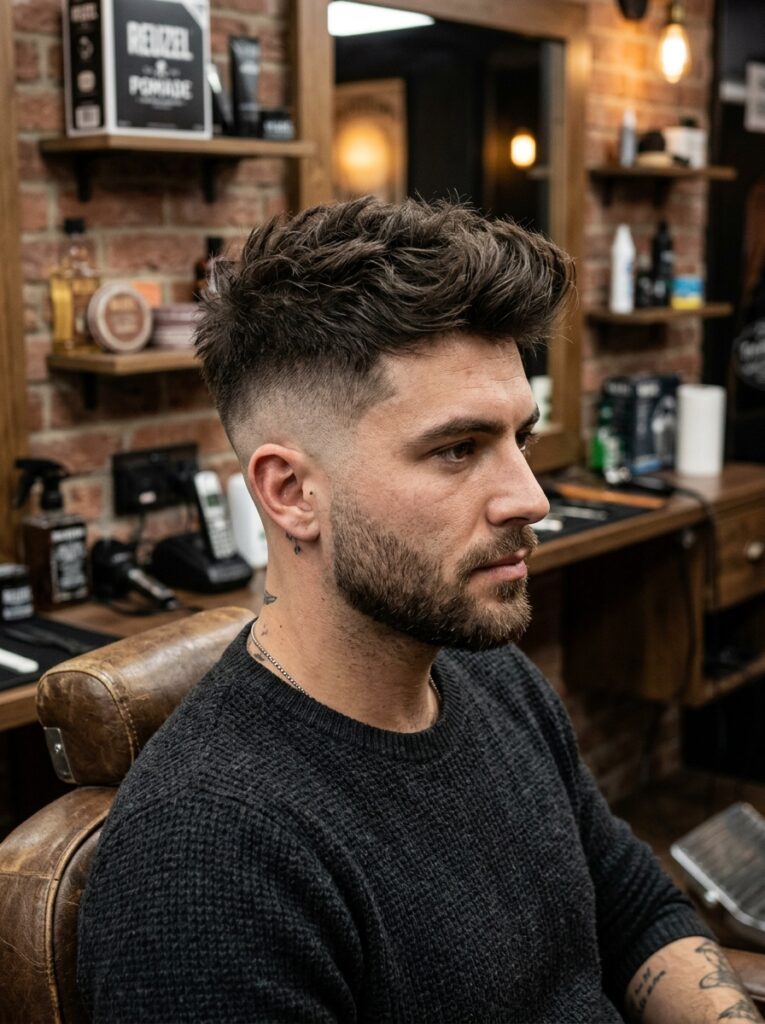
This works on perception rather than on the hair. Taking the sides very short creates a contrast that makes the top read as full, whatever its actual density.
It also removes hair from the temples, which is exactly where thinning shows first. Less competition at the sides means the eye travels upward. Fade heights are compared in our fade haircuts guide.
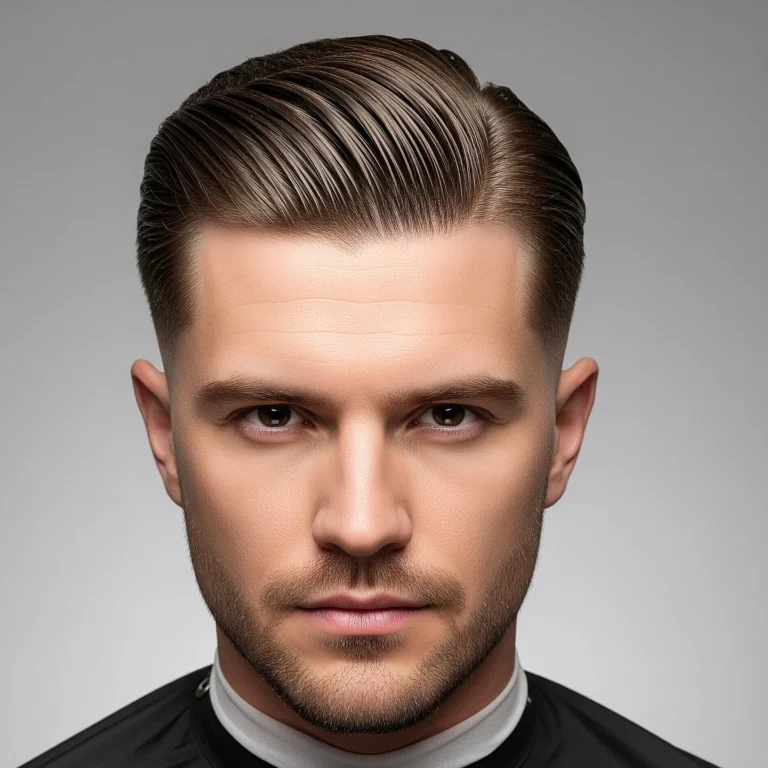
Side Part
Guiding hair to one side creates soft visual mass across the top while tapered sides keep the silhouette neat. It suits offices and social settings equally, which is most of why it endures.
Use a matte pomade rather than anything with shine. And switch which side you part on every few weeks, because hair trained in one direction for years develops a permanent flat channel along the part line.
Quiff

Vertical height makes every strand contribute to the shape. Even sparse hair reads as fuller when it occupies space rather than lying flat against the scalp.
This is a fine-hair style, not a thinning-crown style. If the crown is sparse, the upward direction exposes it. Volumising mousse on damp hair, blow-dry up with a round brush, finish with lightweight clay.
Crew Cut
Short and uniform, with no long section to flatten during the day and no coverage strategy that can fail at the wrong moment.
Leave enough length on top for slight texture, pair with a tapered fade, and add a touch of matte clay at the front. It is the lowest-anxiety haircut in this guide.
Caesar Cut

The short horizontal fringe sits forward across the forehead, which builds density exactly where a receding front hairline shows.
This is the clearest example of styling forward rather than up. It needs minimal product, works across most face shapes, and asks nothing of the morning. Use matte wax and avoid gel entirely, since shine separates fine strands and makes the scalp more visible rather than less.
French Crop with Fade
A longer fringe against closely faded sides. The heavy contrast pulls attention toward the fringe and away from a sparse crown.
Blow-dry the fringe slightly forward, finish with light matte wax. Oval and angular faces suit it best, since the horizontal fringe line frames them cleanly.
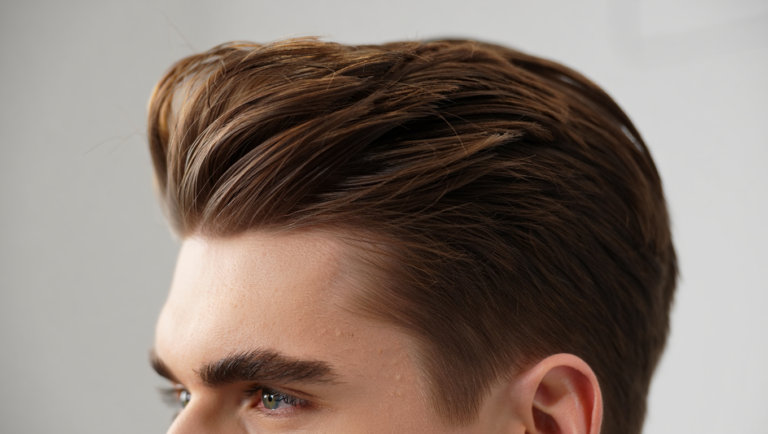
Pompadour

The most commanding option here, and the most conditional. It needs genuine density across the top to work.
If the crown is sparse, the upward styling reveals it rather than hiding it. This is a fine-hair cut, not a thinning-crown one. Blow-dry upward with your fingers and use volumising mousse. Heavy pomade defeats the entire purpose.
Buzz Cut
The boldest choice and, for many men, the most freeing. Cutting everything to one short length removes the visible contrast between thin and full areas entirely.
The hair stops looking like it is struggling and starts looking like a decision. Adding stubble or a shaped beard shifts the visual focus to the jaw and compensates fully for the reduced volume above, which is covered in our guide to matching a beard to a haircut.
One practical note before committing: a buzz cut exposes the scalp to sun. Get a hat for long days outdoors.
Messy Layered Hair

Choppy uneven layers create lift that blunt-cut hair cannot. The movement draws attention to the style’s character rather than the hair’s density.
Texture powder at the roots before blow-drying, then shape with fingers. Nothing structured, nothing heavy.
Ivy League
Slightly longer than a crew cut, with enough length for clean layering and a structured part. It is the most polished everyday option for professional settings.
Ask for uneven layering through the top, which adds texture and disguises sparse patches without looking remedial. Lightweight matte pomade, and blow-dry the roots before any product goes near the hair.
Bro Flow

Medium length brushed back, relying on movement rather than density. Hair in motion reads fuller than hair at rest, which is the most underrated principle in this whole category.
Naturally wavy hair benefits most. This is a fine-hair option rather than a thinning one, since brushing back exposes the hairline. Our guide to medium-length hairstyles covers the grow-out if you are starting short.
Products: What Helps and What Quietly Ruins It
The wrong product undermines even a well-chosen cut, and most men with thin hair are using one.
Texture powder is the most effective single product available. A small amount at the roots makes fine hair look noticeably thicker in seconds, with no residue. Volumising mousse on damp hair before blow-drying adds flexible fullness. Matte clay and matte paste give hold without shine.
Anything glossy is the mistake. Gel and shiny pomade pull strands into clumps, and clumped hair shows scalp between the clumps. That is the opposite of what you want.
One more habit worth dropping: applying product to dry hair. It grips unevenly and you end up using three times as much.
The Heat Problem Nobody Mentions
Almost every style above involves blow-drying upward from the roots. That advice is sound, and it comes with a cost that these guides rarely acknowledge.
Dermatologists list aggressive heat styling among the everyday habits that damage hair. Fine strands have less structure to lose than coarse ones, so they break sooner under the same heat.
Three adjustments keep the volume without the damage. Use medium heat rather than high. Hold the dryer further from the scalp than feels natural. Finish on the cool setting, which sets the shape better than heat does anyway.
When It Is Worth Seeing a Doctor
Most thinning in men is gradual, hereditary and entirely normal. A haircut is the right response to it.
Some patterns are not that, and a haircut is the wrong response. Hair coming out suddenly or in handfuls. Loss in distinct round patches rather than a receding pattern. Redness, scaling, itching or soreness on the scalp. Thinning that starts unusually young or moves unusually fast.
Those warrant a conversation with a doctor or dermatologist rather than a barber, because several of the causes behind them are treatable when caught early. Styling around them simply costs time.
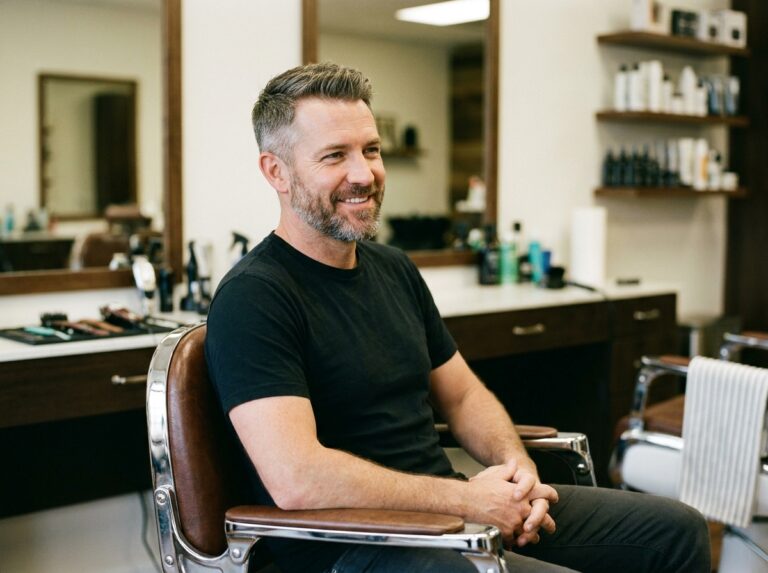
What to Say to Your Barber

This is the step most men skip, and it costs them more than any product choice.
Say where it is thinning before the cutting starts. Point at the crown, the temples or the front. A barber who knows the map makes different decisions about where to leave weight.
Be concrete. “Shorter sides, more texture on top” and “choppy layers for volume” are instructions anyone can follow. “Something that looks fuller” is not.
Then ask one specific question: do they use point cutting or razor texturing on fine hair? Those techniques are what create visual volume, and a barber who does not reach for them by default will still do it when asked.