
Mirror Decor Ideas for Home: Stylish Ways to Transform Any Space

A mirror does more for a room, for less money, than almost any other decorating decision. It adds light, depth and apparent space without touching the structure.
It is also the decision most often made backwards. People choose the frame, hang it where there is a gap, and hope. The frame is the least important part.
A Mirror Only Shows You What Is Opposite It
This is the whole thing, and almost no guide says it. A mirror has no content of its own. It doubles whatever is in front of it, good or bad.
Before deciding anything about the mirror, stand where it will hang and look at what faces it.
A window opposite is the best case. The mirror pushes daylight back across the room, which is why north-facing and poorly lit rooms benefit most.
A blank wall opposite does nothing. The mirror reflects an empty surface and contributes light but no interest.
A cluttered surface opposite is the common mistake. A mirror facing a crowded shelf or a worktop doubles the clutter rather than the style.
A doorway opposite needs checking. It shows whatever is in the next room, including the parts you do not want on display.
Tilting a mirror slightly downward or angling it toward a hallway, a doorway or a garden view adds depth that a flat, straight-hung mirror cannot. That adjustment costs nothing and changes the result completely.
Size and Height
Two numbers cover most situations, and they are the same proportions that govern artwork.
A mirror over a console table or a sofa should span roughly two thirds of the furniture’s width. Narrower and it floats; wider and it overwhelms.
Hang it so the centre sits around 145 to 150 centimetres from the floor, which is eye level for most people. Over furniture, leave 15 to 20 centimetres between the top of the piece and the bottom of the mirror. The same rules across a whole wall are covered in our guide to modern wall decor ideas.
Round Mirrors

The most universally applicable shape, and the safest choice if you are unsure.
The reason is contrast. Most rooms are rectangles full of rectangles, so one circular form softens everything around it without any coordination decision.
Wooden frames add warmth to neutral and Scandinavian rooms. Frameless suits minimal spaces. Scalloped wood adds an artisanal quality without shouting.
Floor-Length Mirrors

The highest-impact option for small, confined or low-ceilinged rooms. A full-length mirror creates depth and makes a narrow room read taller immediately.
A leaning mirror needs no installation, which makes it the answer for renters. Frameless or minimal-frame versions suit modern interiors.
Placed in a dark corner it opens the space up, which is one of several approaches in our guide to empty corner decor ideas. One caution: a leaning mirror must still be secured, and the last section explains why.
Arched Mirrors
The curved top adds architectural height that a rectangle cannot, which is why arched mirrors have stayed in demand rather than spiking and fading.
They suit hallways, living rooms and bedrooms equally. A pair hung together creates a stronger design moment than one alone.
A vintage gold arch reads as modern luxury referencing classical proportion. It works in contemporary, transitional and traditional rooms without adjustment.
Sunburst Mirrors
The boldest single piece in the category. The radiating frame draws the eye immediately and anchors a wall around one focal point.
Above a mantel it reflects firelight across the room in the evening. Above a console it creates symmetry with the furniture below.
Match the frame finish to the metals already in the room. Brass, copper and gold all work, provided you commit to one rather than mixing.
Ornate and Vintage Frames

These bring something new pieces cannot fake: the sense that the room accumulated rather than arrived.
Gold, brass and distressed wood ground an otherwise modern interior. Above a mantel or in a dining room, an ornate frame can carry real visual authority.
They suit transitional, glam and eclectic rooms naturally, and work as deliberate contrast in contemporary ones. This is also the mirror type most worth buying secondhand.
Geometric Mirrors

Hexagonal, diamond and angular shapes add rhythm that round and rectangular formats do not.
Start with one large anchor piece, then add smaller shapes around it for balance. Adhesive mirror tiles give a renter-friendly version that moves without damage.
A run of hexagons in a kitchen reflects light and makes a compact cooking space read larger.
Wavy and Organic Shapes

Cloud, teardrop and freeform shapes push the mirror into sculptural territory, where it functions as art with a reflective surface rather than a mirror with a nice frame.
They suit entryways, eclectic bedrooms and creative spaces, and they soften the straight lines that dominate most rooms.
Wooden or clay-textured frames keep an organic shape grounded in the room’s materials rather than floating free of them.
Mirror Gallery Walls
Multiple mirrors in different shapes and sizes, arranged as one composition. It suits hallways and walls with no natural focal point.
Mix round, square, hexagonal and ornate. Vary the heights so the arrangement has rhythm rather than sitting in a flat row.
Including framed artwork alongside the mirrors adds contrast between reflective and matte surfaces, and makes both look more deliberate. Lay it all on the floor first.
The Living Room
This is where placement pays off most, because it is the most looked-at room in the house.
A large mirror above the sofa creates a focal point and opens the room. Flanking it with two wall sconces doubles the light and adds symmetry in one move, which is covered further in our guide to lighting decor ideas.
A round mirror against a deep, moody wall colour reads as curated rather than decorated. Check what the sofa mirror faces before hanging it, since it will be reflecting the opposite wall all day.
The Entryway

The entryway gets the strongest return per pound of anywhere in the house, because it sets the expectation for every room after it.
A statement mirror above a console table is the standard arrangement for a reason. Add lamps, flowers, and one or two chosen objects rather than a crowd of them.
Entryways are usually narrow, which makes them the place where a mirror’s light-bouncing does most work. A leaning floor mirror achieves it with no installation at all.
The Bedroom
Bedroom mirrors have to earn their place twice: daily function and visual contribution.
A mirrored wardrobe door does both and reclaims a whole wall. A full-length mirror leaned or hung covers the practical need. An arched mirror adds height without crowding the furniture.
One placement worth thinking about: a mirror facing the bed reflects the bed, which some people find unsettling at night. Facing a window or a wardrobe is usually the better position. Small-room approaches are covered in our guide to small bedroom decor ideas.
The Bathroom

The most used mirror in the house, and the one most often chosen on purely functional grounds.
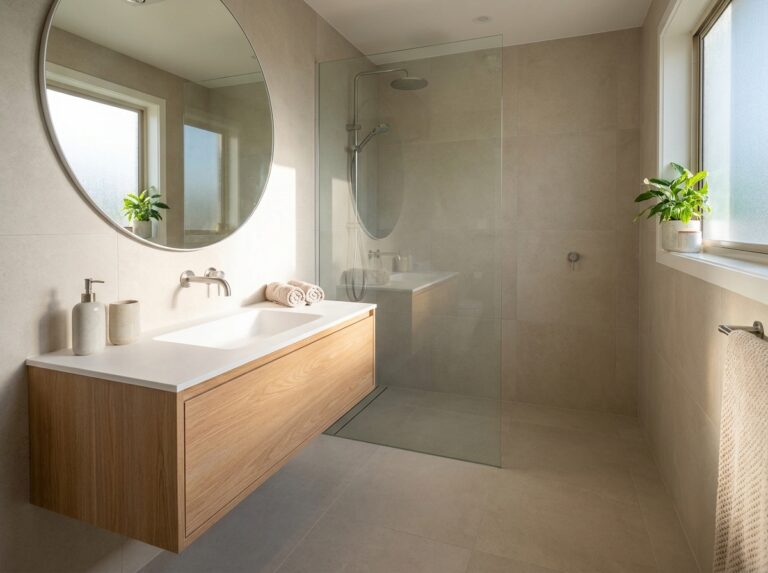
A wooden-framed round mirror softens tiled surfaces and stops a bathroom reading clinical. An arched mirror above the vanity adds height. Two matching mirrors over a double vanity give symmetry.
Integrated LED strips provide light at face level, which is genuinely better for shaving and grooming than an overhead fixture casting shadows downward.
Mirrored Furniture and Surfaces
Taking the mirror off the wall and into the furniture distributes the same light-bouncing effect through the room.
A mirrored console in an entryway, a mirrored kitchen backsplash, or full-height panels in a home gym all work for the same reason.
Be realistic about upkeep. Mirrored surfaces show every fingerprint, which makes a mirrored coffee table a poor choice in a house with young children and a good one in a formal room nobody touches. Lower-cost approaches are in our guide to budget friendly home decor.
Anchor It to the Wall
Large mirrors are heavy, and leaning ones are the least stable objects in most homes. This section exists because no mirror guide includes it and it matters more than any styling decision here.
Guidance from the American Academy of Pediatrics on preventing furniture tip-overs names mirrors specifically: secure all furniture and mirrors with anti-tip devices. It also recommends metal brackets over plastic ones, because plastic becomes brittle over time and fails.
Anchor into a stud rather than into plasterboard alone. That may mean moving the mirror slightly from the ideal position, and it is worth the compromise.
The anchors cost very little and take minutes. A leaning floor mirror in a room a child uses should be strapped to the wall regardless of how stable it feels when you set it down.