Small Entryway Decor Ideas to Make a Great First Impression
The entryway is the first room of the house, and it is almost never designed. It is the strip of floor where shoes accumulate, post gathers, and coats end up over the bannister.
That is the actual problem, and it is worth naming before any decorating starts. A small entryway does not look untidy because it lacks a nice console. It looks untidy because four specific things have nowhere to go.
Solve the Four Piles First
Walk to your front door and look at what is actually on the floor and the nearest flat surface. It will be some combination of shoes, coats and bags, keys and post.
Every idea below is organised around which of those it solves. Decorative pieces come afterwards, because an entryway with beautiful styling and nowhere to put shoes still looks bad by Wednesday.
One measurement matters before buying anything. A console deeper than 30 to 35 centimetres starts eating walking space in a narrow hall, and that friction is felt every single day.
For the Shoe Pile: A Slim Shoe Cabinet
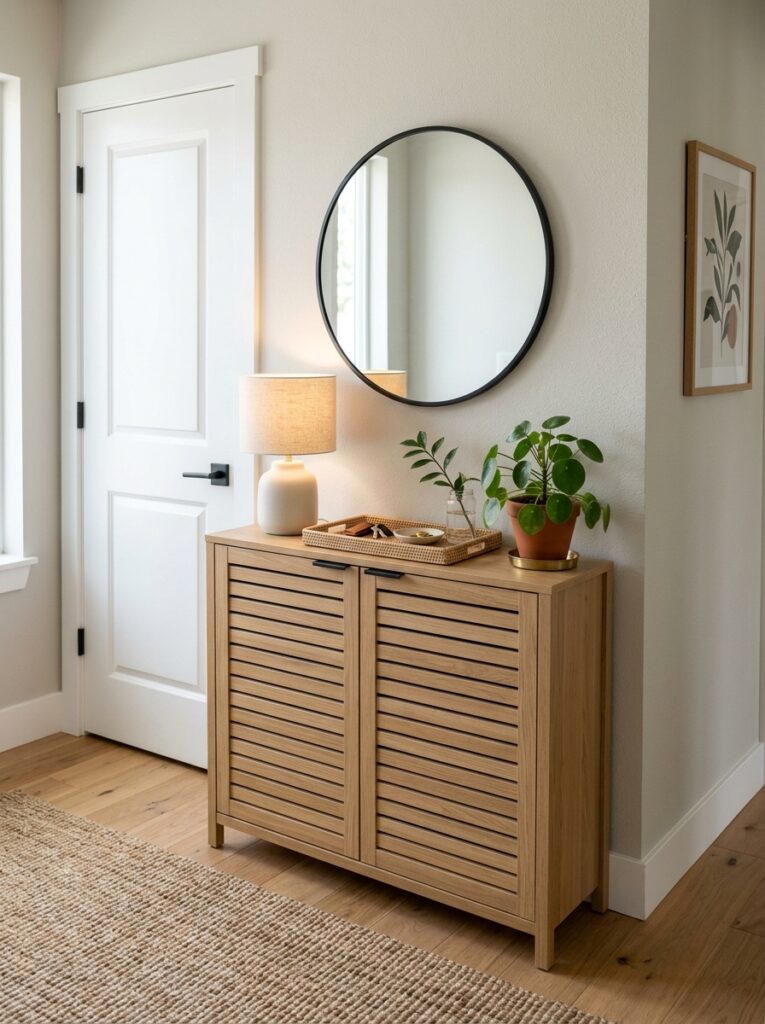
Shoes are the most consistent source of entryway mess, and a cabinet with doors solves it at the root rather than managing it afterwards.
Narrow enough to sit against a wall without intruding on the walkway. Models with angled interior shelving hold far more pairs than their footprint suggests.
The top surface immediately becomes useful for a lamp or a tray, which means one piece of furniture handles two of the four piles.
For the Shoe Pile: An Entry Bench With Storage
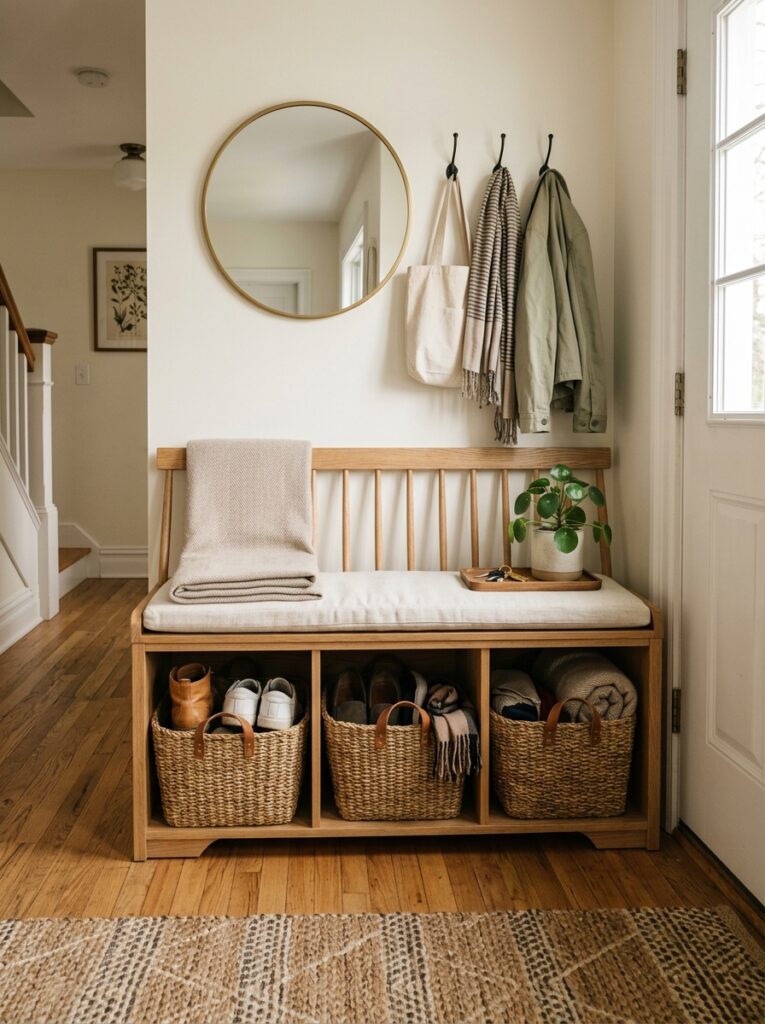
The bench earns its floor space twice: you sit on it to put shoes on, and the storage underneath holds them.
Open cubbies, woven baskets or a lift-top compartment all work. A bench that only seats and does not store is a missed opportunity in a small hall.
A folded throw or a cushion on top stops it reading as pure utility. In a wooden farmhouse version, that layering is most of the appeal.
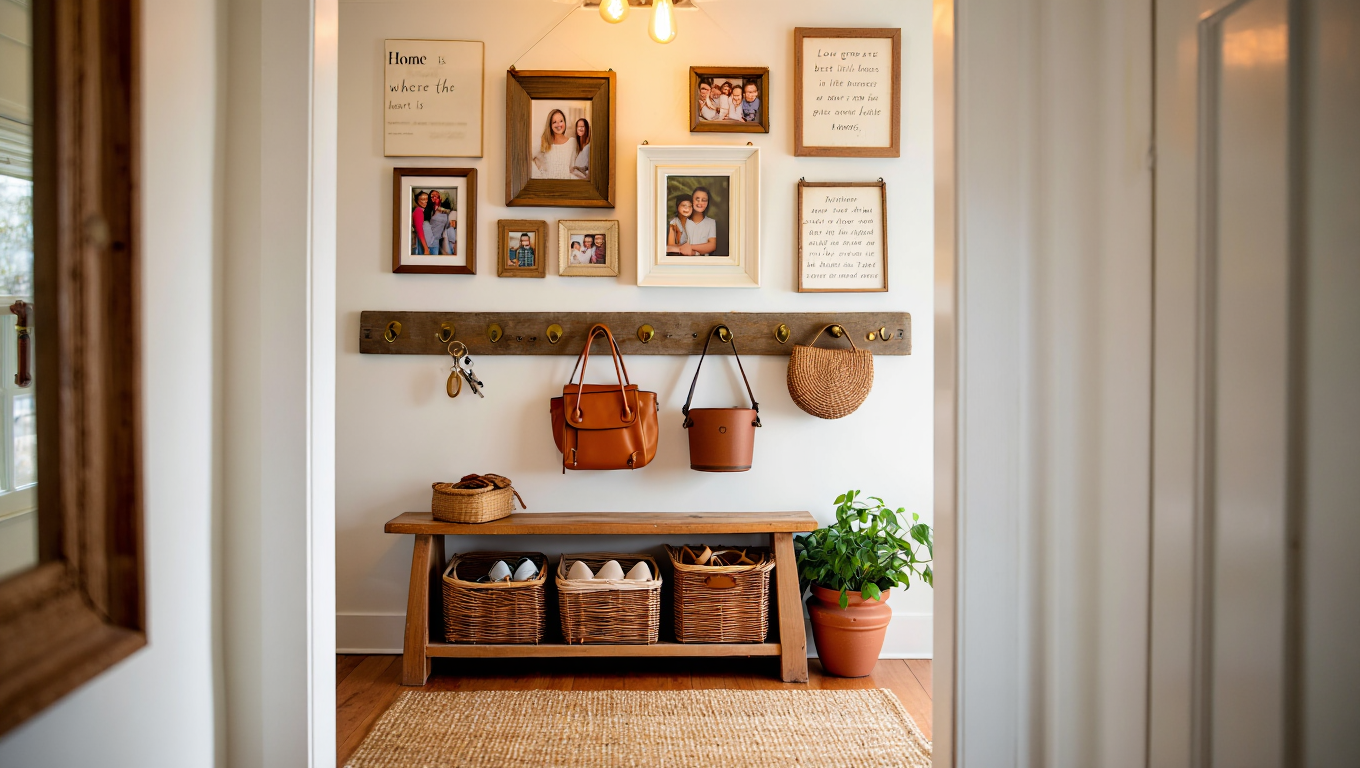
For the Coat Pile: A Wall-Mounted Rack
The most space-efficient storage an entryway can have, because it uses zero floor space.
A row of simple Shaker pegs painted to match the wall looks clean and deliberate. A rack with varied hook heights adds character and handles children’s coats at a reachable level.
In a hall too narrow for any furniture at all, a rack on one wall and a mirror on the other covers most of what an entryway actually needs to do.
For the Coat and Key Piles: A Floating Shelf With Hooks
The combined answer, and the right one when the hall is genuinely too tight for furniture.
Shelf at head height, hooks underneath. Bags and coats hang below, keys and sunglasses sit above, and the floor stays completely clear.
Painted the same colour as the wall, the whole arrangement visually recedes while still doing all its work. A small plant or candle on the shelf adds the decorative layer without costing anything functional.
For the Key and Post Pile: A Narrow Console
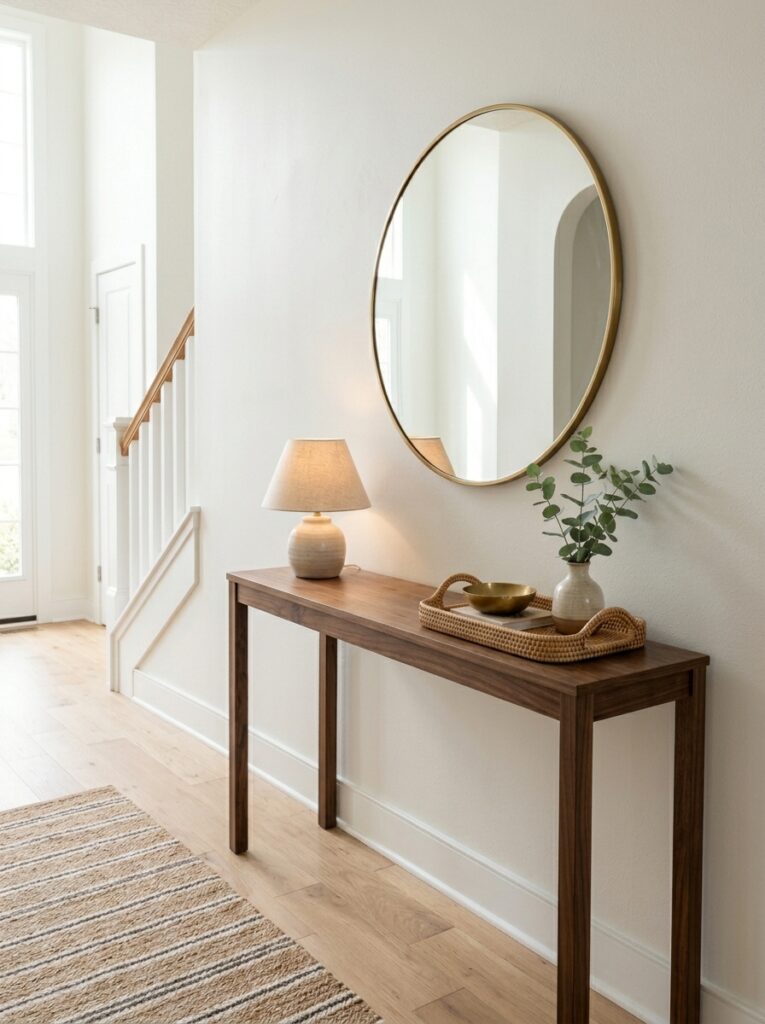
A console with a mirror above it is the most effective single combination available, because the table catches the daily objects and the mirror handles the light.
Style the surface with three things only: a lamp, a tray, one object. The tray is the functional part, because it contains keys and post instead of letting them spread across the whole surface.
More than three objects and the console becomes another pile, which is the exact outcome it was bought to prevent.
For Everything Else: Woven Baskets
The cheapest fix on this page and the most adaptable. A large basket by the door takes umbrellas, sports kit and whatever else has no category.
A smaller one on a shelf corrals chargers and the daily small items that otherwise scatter.
Rattan and seagrass suit almost every interior style, and they add natural texture that plastic storage boxes cannot.
The Mirror Is Doing Two Jobs
A large round mirror softens the hard angles of a narrow hall and makes the space read wider, all from one wall fitting.
Position matters more than the frame. A mirror opposite a window or a lamp bounces light down the corridor. A mirror facing a blank wall reflects nothing and contributes very little.
Brass, black and natural wood frames all work. More on placement is in our guide to mirror decor ideas.
Light It From Below Head Height
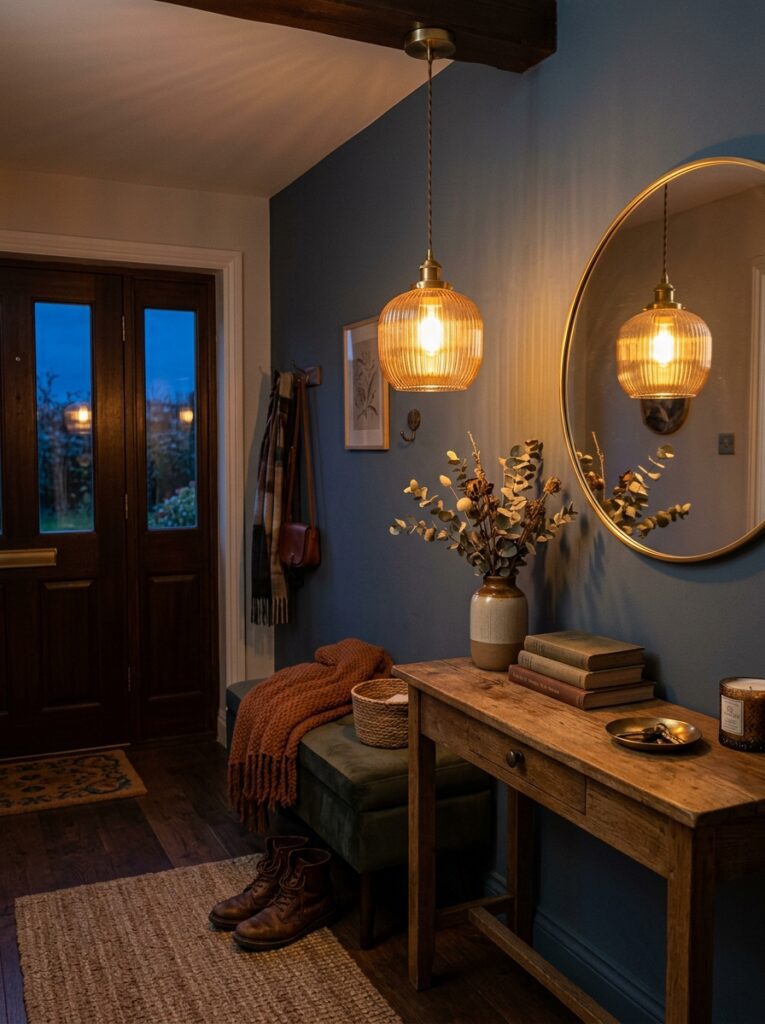
Entryway lighting is underestimated because people pass through rather than sit. That misses the point: this is the space that sets the tone on arrival.
A single lamp on a console changes the atmosphere more than any ceiling upgrade, because light at waist or shoulder height creates warmth that an overhead fitting cannot at any temperature.
Use warm white bulbs around 2700 Kelvin. Cool white makes a narrow hall read clinical, and the reasoning is in our guide to lighting decor ideas.
The Runner Rug, and One Safety Point
A runner adds warmth underfoot, protects the floor from shoe traffic, and visually defines the entry as its own zone. A pattern also hides the dirt shoes bring in.
There is a genuine hazard worth knowing about, though, and decor guides never mention it. The entryway is a high-traffic strip where people arrive carrying things, often in a hurry.
The National Institute on Aging’s room-by-room advice on preventing falls at home is direct about it: check that carpets are fixed firmly to the floor so they cannot slip, use no-slip strips on tile and wooden floors, and avoid loose throw rugs and small area rugs altogether.
In practice that means a low-profile runner with a non-slip backing or rug tape, not a loose mat that slides on tile. It matters most in a household with older adults or young children.
A Plant Makes It Look Inhabited
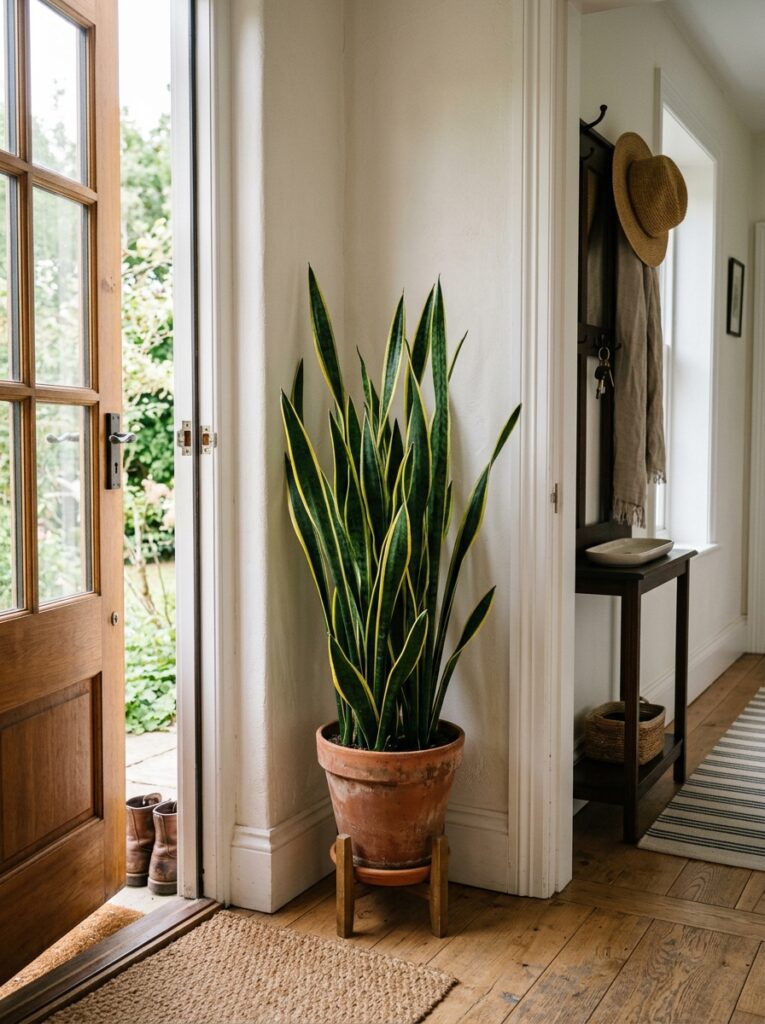
One plant does something no object can. It makes the space read as lived in rather than staged.
A tall narrow species takes minimal floor space while adding height. A trailing plant on a shelf needs no floor at all.
Entryways are often the darkest part of a home, so be honest about the light. A good faux plant beats a real one slowly dying by the door, and check any species against a pet-safe list if you have animals.
A Gallery Wall Sets the Tone
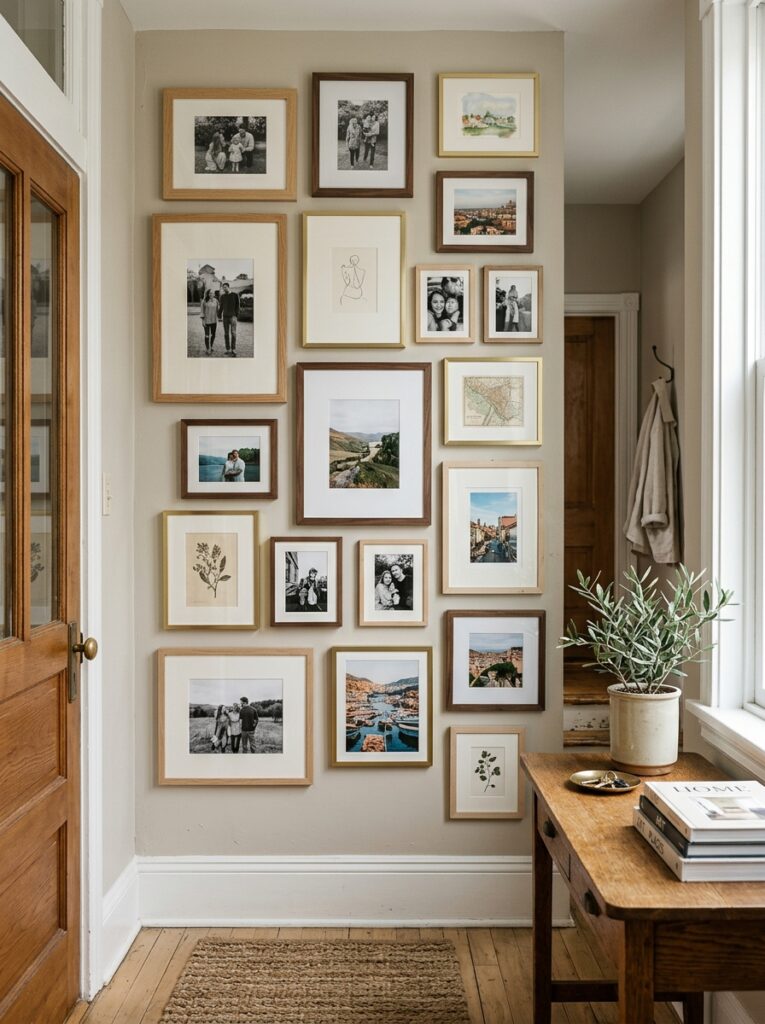
A gallery wall uses vertical surface that would otherwise stay blank, and it tells visitors something about the household before they have walked three steps.
Perfect symmetry is not the goal. Mixed sizes read as collected rather than bought. Keep the frames within one colour family so the wall does not read as chaotic.
When it is working, nothing else in the entryway has to try hard. Arrangement and hanging heights are covered in our guide to modern wall decor ideas.
Wallpaper Belongs Here More Than Anywhere
An entryway is the ideal place for a bold pattern precisely because it is small and because people pass through quickly rather than sitting in it.
A print that would overwhelm a living room feels deliberate on one narrow wall. Botanicals, geometrics, grasscloth and tonal abstracts all suit it.
Keep everything else neutral so the paper is not competing. Peel-and-stick versions make it available to renters.
Black and White, If You Want It Simple
White walls with black frames, hooks or a black console produce a strong result with very few decisions, which is why it suits people who do not enjoy decorating.
The contrast stops it reading bland; the restraint stops any one element dominating.
Add one warm element — a plant, a ceramic vase, a textured runner — or the palette tips into feeling staged.
The Styled Console, Once Everything Else Works
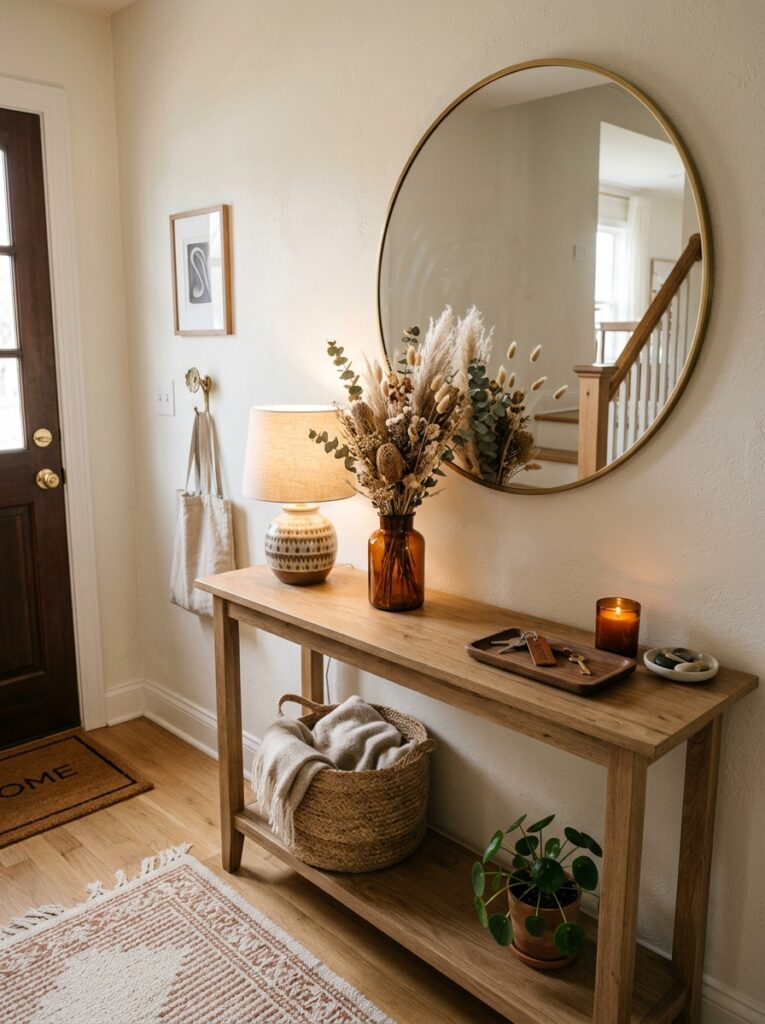
Lamp, tray, vase. That is the whole composition, and the discipline of keeping it to three is what makes it read as styled rather than furnished.
Fresh or dried flowers add the living quality. The tray keeps the daily objects contained so the surface does not accumulate through the week.
This produces the strongest first impression of anything here, but only in an entryway where the four piles already have homes. Otherwise it becomes the place they land.
A Wooden Bench for Warmth
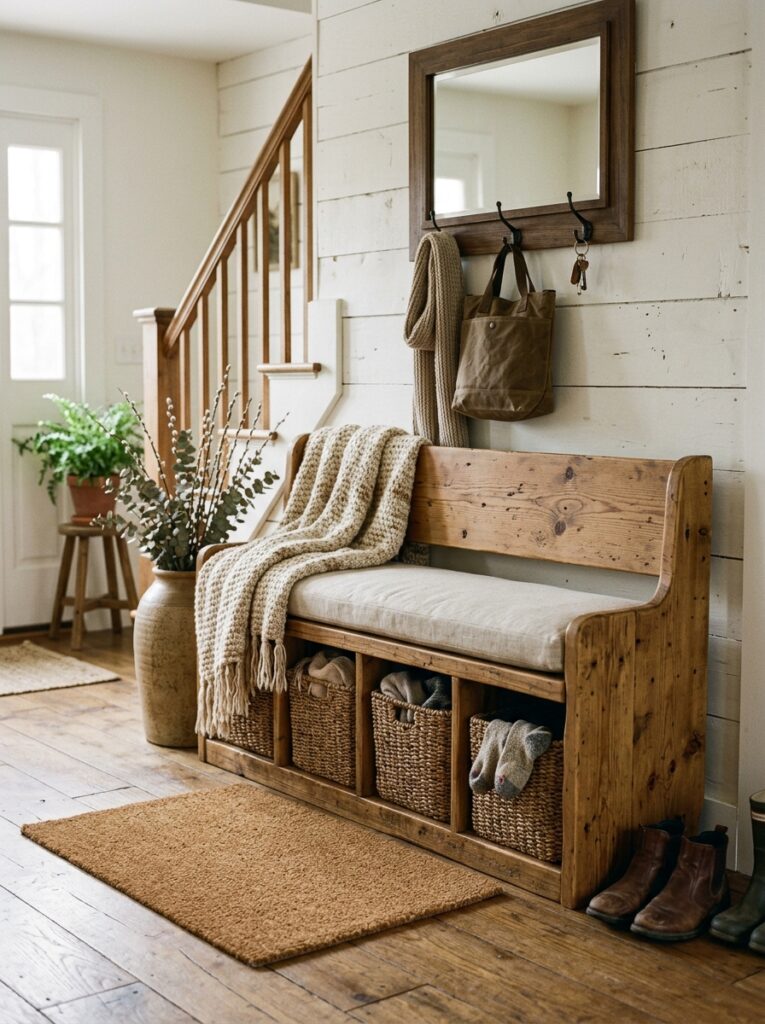
Natural wood communicates something painted furniture does not, and in a small hall that warmth carries a long way.
Baskets beneath, a cushion on the seat, a throw over one end. That layering suits modern, transitional and rustic homes equally, because wood belongs in all of them.
It also signals that the entry was set up for daily life rather than for a photograph, which is most of why it feels welcoming.
The Test That Decides Everything
In a small entryway, every piece has to justify its footprint by doing more than one thing.
A console that looks good but stores nothing is a worse use of the space than one that does both. A bench that seats but does not store is half a purchase. A mirror positioned to reflect a blank wall is decoration where it could have been light.
Apply that test before buying and the entryway solves itself. The exterior side of the same first impression is covered in our guide to modern home entrance design, and narrow leftover spaces elsewhere in the house are in our guide to empty corner decor ideas.