Low-Maintenance Boys’ Haircuts for Busy Mornings
A good boys’ haircut does not just look right on the day it was cut. It holds up through school, sport and swimming for weeks, without asking anything of the morning.
Plenty of cuts fail that test. They look sharp in the chair and untidy by Thursday. What separates the ones that last is not the style name, and it is worth understanding before picking from any list.
What Actually Makes a Cut Low-Maintenance
Three things decide it, and only one of them is the style itself.
How it grows out. A cut with high contrast between top and sides looks wrong as soon as the sides catch up. A cut with a soft transition just looks slightly longer. That is the whole difference between a skin fade and a low taper.
Whether the texture is cut in. If the barber points the ends so the hair sits with movement, it looks styled with no product. If the top is cut blunt and flat, product is the only thing that will save it every morning.
The neckline. The most overlooked detail on this page, and the one that does the most work. Covered in full below.
Ask for a Natural Neckline, Not a Squared One
If you take one thing from this guide, take this. It costs nothing, takes no extra time, and extends every cut here.
A squared neckline is cut in a straight line across the nape. It looks sharp for about a week. Then the hair grows below the line and the square becomes a visible, untidy edge sitting above fresh growth.
A natural tapered neckline follows the hair’s own growth pattern and fades out. As it grows it simply becomes less defined rather than becoming wrong.
That single request at the chair buys one to two extra weeks before the grow-out looks noticeable. For families stretching appointments to six or eight weeks, nothing else on this page comes close.
Needs Nothing At All: The Buzz Cut

No routine, no product, no comb. It looks the same at the end of an active day as it did at the start.
The modern version uses a number two or three rather than the old military settings, which gives a more considered finish at no extra cost in upkeep.
It grows out evenly and keeps looking deliberate for several weeks. Boys in contact sport or swimming choose it repeatedly, and for good reason.
Needs Nothing At All: Crew Cut with a Taper
One step up in length. Enough hair on top to show texture, with a taper at the sides and neckline that reads as maintained rather than simply short.
No product is needed for it to look neat through a school day, and it still looks intentional several weeks on.
A touch of matte clay takes under a minute on days that need something sharper, like photographs. It is optional rather than structural.
Needs Nothing At All: Textured Crop with a Fade

The clearest example of texture doing the work. Because the movement is cut into the top, the hair sits with dimension straight after drying with nothing applied.
It also ages well, since choppy layers keep their character as they grow where blunt cuts lose theirs.
Straight and wavy hair both take it. The full version is in our guide to the textured crop for boys.
Needs Nothing At All: Low Fade with a Natural Top
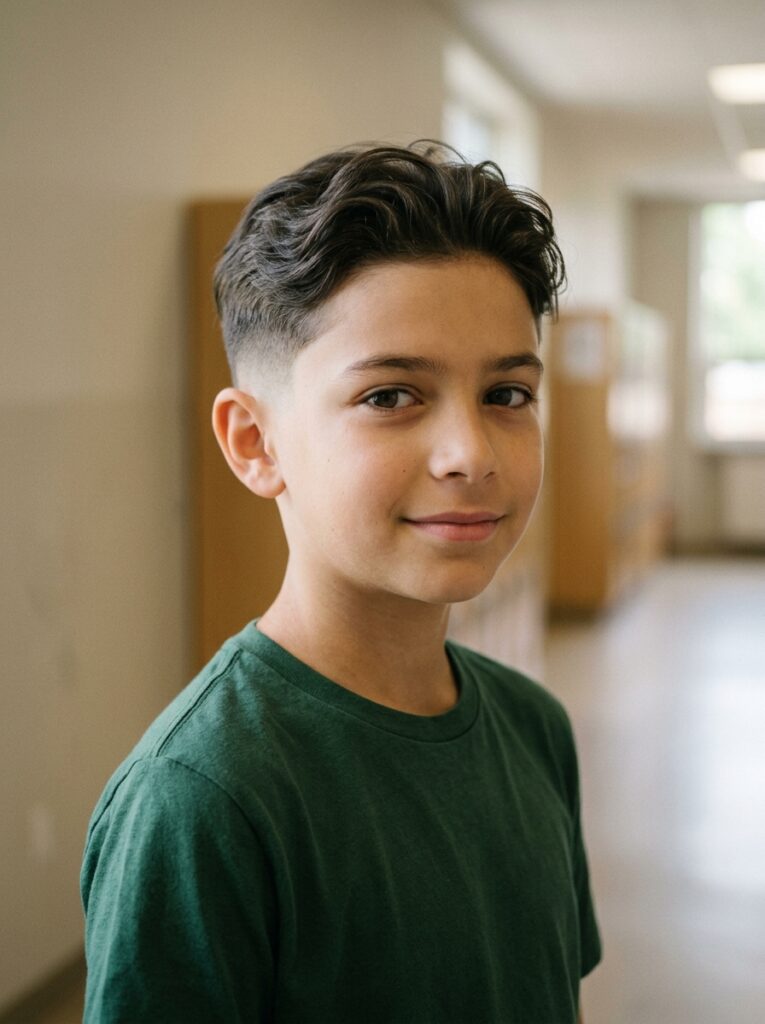
For boys whose hair has real texture, this works with what the hair already does rather than trying to control it.
The low fade keeps the perimeter clean. The top is left alone after washing.
Natural waves often look better in week three than week one, which makes this one of the few cuts that improves between appointments. How to ask for each fade height is in our taper fade guide.
Needs Nothing At All: The French Crop
The most genuinely self-maintaining cut here. The blunt horizontal fringe holds its forward position by its own weight, with no product involved.
The sides stay short with a fade or taper and need no daily attention. The fringe stays put through an active day because of how the weight sits.
One caveat: very curly hair pushes the fringe upward instead of forward, so ask for a shorter, more textured fringe in that case.
Needs Nothing At All: Messy Natural Top with a Fade
The cut that improves as it is worn in through the week rather than declining from its barbershop peak.
The fade keeps the sides structured. The top develops its own movement through the day with no product at all.
The deliberate messiness reads as confident rather than neglected, which is what the fade underneath is doing for it.
Thirty Seconds: The Side Part
A comb and a small amount of light-hold product, about thirty seconds. In return it is the easiest genuinely polished cut a boy can have.
It grows out gracefully, because the longer top absorbs the extra length without losing its neatness.
Ask the barber to cut along his natural parting rather than against it. Cut against the growth, and you will fight a cowlick every morning for six weeks. School-appropriate options are covered in our guide to school haircuts for boys.
Thirty Seconds: Comb Over with a Low Fade

The top falls into its intended direction after towel-drying, because the growth pattern and the weight guide it there without much help.
A little light-hold cream sharpens the direction for occasions, but it is genuinely optional on ordinary school days.
It reads more deliberate than the effort behind it, which is exactly why parents keep coming back to it.
Thirty Seconds: Curly Top with a Short Fade
For curly-haired boys this is often the first cut that makes daily hair management feel possible.
The fade removes bulk at the sides, where it builds most visibly. The curly top expresses itself after washing.
A light curl cream on damp hair before air drying handles definition and frizz. More by curl type is in our guide to boys’ haircuts for curly hair.
Thirty Seconds: Short Back and Sides with a Longer Top
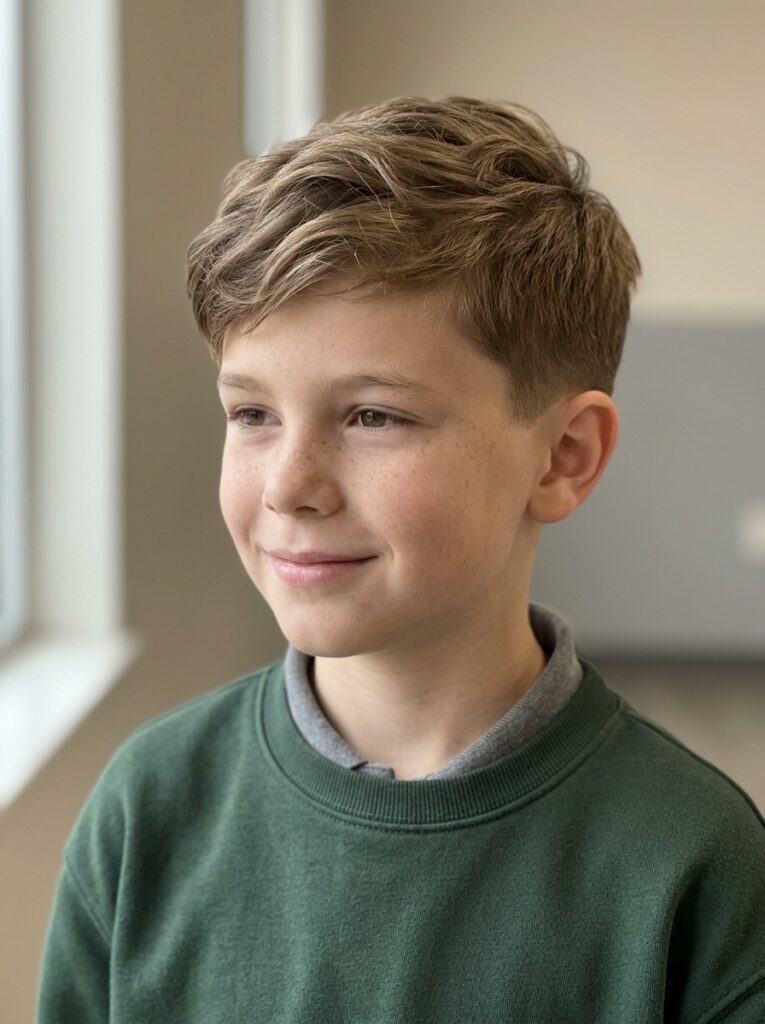
The classic, and the best choice for families who cannot manage monthly appointments.
It stays neat and proportionate longer than either very short or very long styles, because the moderate contrast means growth does not break the shape.
Straight and slightly wavy hair suit it particularly well, and it covers weekdays and school events without any change of approach.
Thirty Seconds: The Ivy League
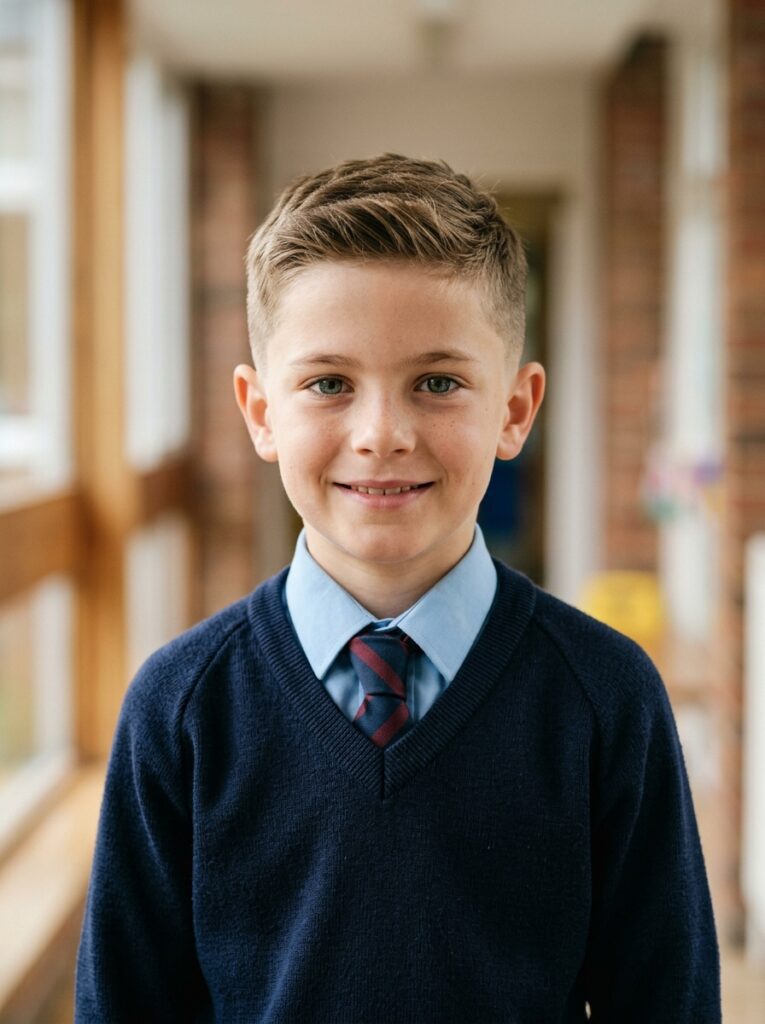
Between a crew cut and a side part. Long enough on top for a comb-through when needed, short enough to look neat without one.
That makes one cut cover both ordinary days and formal occasions with no extra appointment in between.
It grows out evenly and suits most hair types and face shapes without modification, which is covered further in our guide to boys’ haircuts by face shape.
Thirty Seconds: The Scissor Cut
Scissors follow the hair’s natural growth direction rather than cutting uniformly across it, which produces a softer hairline and a more relaxed finish.
That natural quality ages more gracefully between visits than a clipper-only cut does.
It is also worth requesting for a boy who finds clippers distressing. Scissor work is quieter and involves no vibration against the scalp, which removes two of the biggest triggers at a barbershop appointment.
Sharp, But Expect Frequent Visits: The Skin Fade
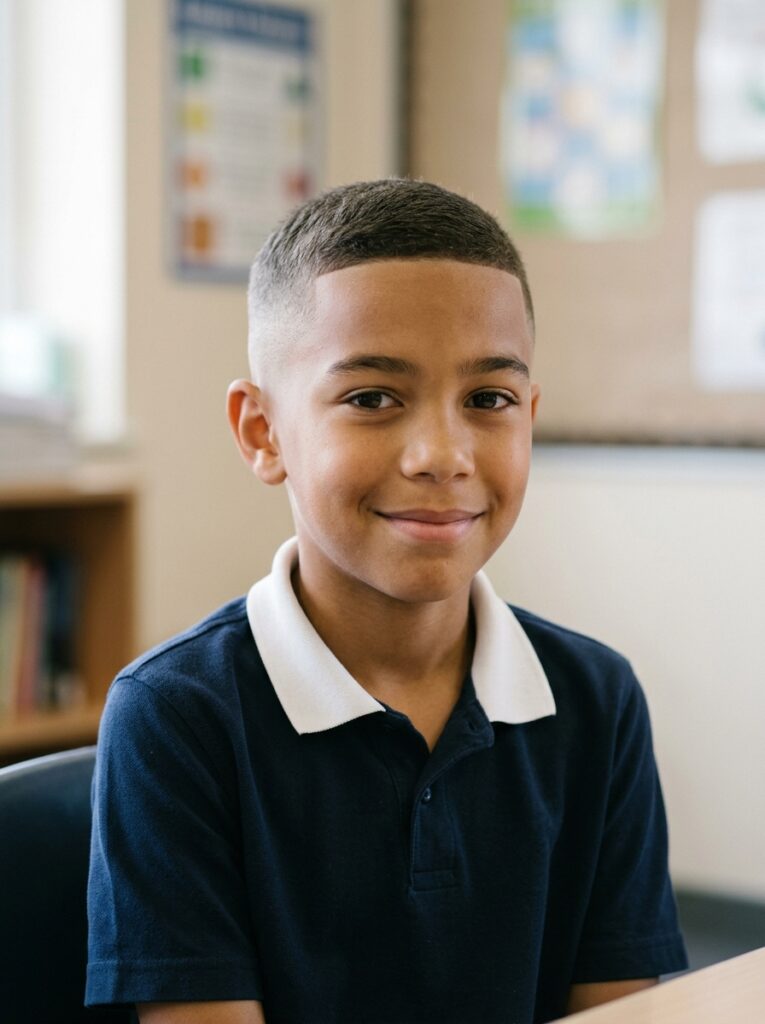
Worth being honest about this one, because it is low-maintenance daily and high-maintenance overall.
Nothing needs combing, shaping or arranging. The hair dries almost instantly and looks identical all day.
But skin fades show regrowth faster than anything else here, which means a barber visit every two to three weeks. If that is not realistic, take a low fade with the same short top instead and lose almost nothing.
Sharp, But Expect Frequent Visits: The Line-Up
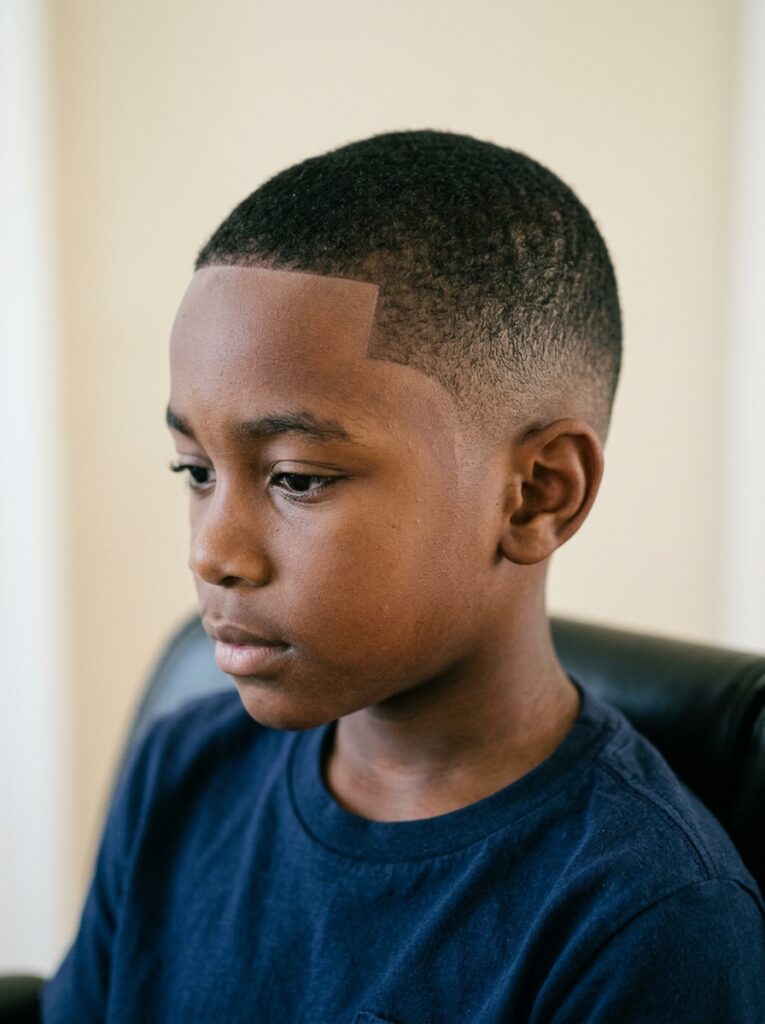
Not a haircut but a finishing technique, and it lifts any simple short cut into something that reads as barbershop quality.
Clean geometric edges at the forehead, temples and sideburns make the whole cut look sharper from every angle, and those edges stay visible even as the hair grows.
The trade is that a line-up softens within about two weeks. Worth adding if you visit often anyway; not worth building a routine around if you do not.
How Often to Wash It
Most parents wash a child’s hair more often than needed, and over-washing is what makes textured hair frizzy and dry.
Guidance from the American Academy of Dermatology on how often children need to wash their hair sets out useful ranges. Most children aged eleven and under need it once or twice a week. Children with dry, curly or coily hair, including braids and protective styles, do better at every seven to ten days.
From twelve onward, or once puberty starts, that changes quickly. So do days involving swimming or heavy sport, which warrant a wash regardless of the schedule.
The practical check is the scalp rather than the calendar. If it looks oily, wash it. If the ends look dry and rough, wash less often or use a gentler shampoo.
Making Any Cut Last Longer
Three habits beyond the cut itself, in order of how much they matter.
Request the natural neckline every single time. It is the free upgrade and most parents never ask.
Apply any product to damp hair rather than dry. It distributes evenly, looks more natural, and you use a fraction of the amount.
Keep a trimmer at home for the neckline between visits. Two minutes restores a noticeable amount of freshness to any fade, and it is the one bit of at-home tidying that is genuinely hard to get wrong.