Boys Haircuts for Every Face Shape: The Perfect Style Guide
Most parents choose a boy’s haircut by pointing at a photo and hoping. Sometimes it works. Often it does not, and the reason is almost always the same: the cut was right for a different face shape than the one wearing it.
Face shape decides what a barber should add, what they should avoid, and where the proportions need to work for the face rather than against it. Anyone can see when a haircut suits a boy, even if they cannot say why. This guide explains the why, shape by shape.
How to Work Out His Face Shape in Two Minutes

Pull his hair back off the forehead and take a straight-on photo in even light. Photos work better than a mirror, because you can look at it properly without him squirming.
Then compare three measurements: forehead width, cheekbone width, and jaw width. After that, compare the overall length of the face against its widest point.
If all three widths are close and the face is slightly longer than wide, it is oval. If width and length are about equal with soft edges, round. Widest at the jaw with visible corners, square. Widest at the forehead tapering to a narrow chin, heart. Noticeably longer than wide with even width throughout, oblong. Widest at the cheekbones with both forehead and jaw narrower, diamond.
One caveat worth keeping in mind. A boy’s face changes shape as he grows, sometimes considerably between ages six and fourteen. The shape you identify today is worth rechecking every year or so rather than treating as permanent.
Oval: The Shape With No Constraints
An oval face is the one barbers are genuinely pleased to see. Forehead and jaw are roughly equal, the face is a little longer than it is wide, and nothing about the proportions needs correcting.
Textured crops, side parts, comb overs, crew cuts, quiffs and the Ivy League all work without modification. The only real guidance is to keep hair off the forehead, since covering it shortens the face slightly and an oval face has no length to spare.
For parents of an oval-faced boy, the barbershop conversation is the easiest one on this list. Let him pick the style he actually wants.
Round: Build Height, Remove Width
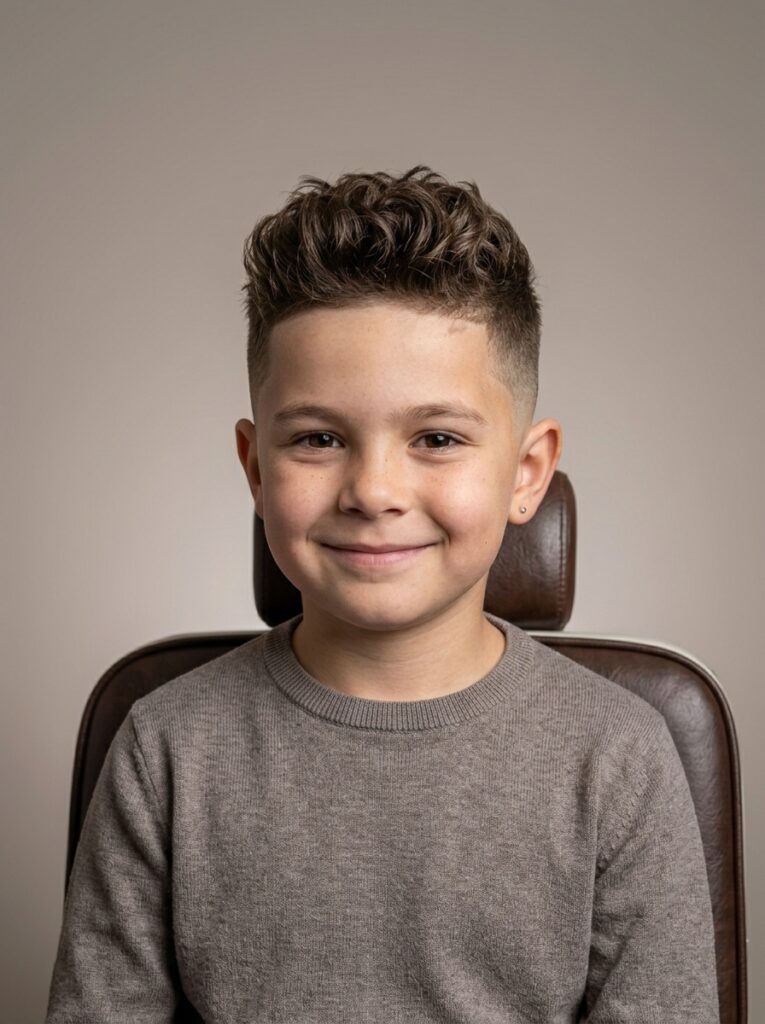
A round face has roughly equal width and length, soft edges, and no strong angles at the jaw or forehead. Every good haircut for this shape does the same two things: adds vertical height and takes width off the sides.
A textured crop with volume, a quiff, or a faux hawk all lift the crown and make the face read longer immediately. A fade keeps the sides close, which removes width at exactly the point where the face is widest.
The faux hawk deserves a specific mention here. It delivers the same proportional formula as a quiff, and it has a second advantage for school-age boys. Worn flat it reads as an ordinary short cut. Styled up it reads as bold. Two looks, one haircut, and the school-friendly versions are covered in our mohawk and faux hawk guide for boys.
What works against a round face is full, untapered hair sitting at cheek level. A side part also helps more than people expect, because a diagonal line across the forehead lengthens a face better than a horizontal one.
Square: Soften the Angles Rather Than Sharpen Them
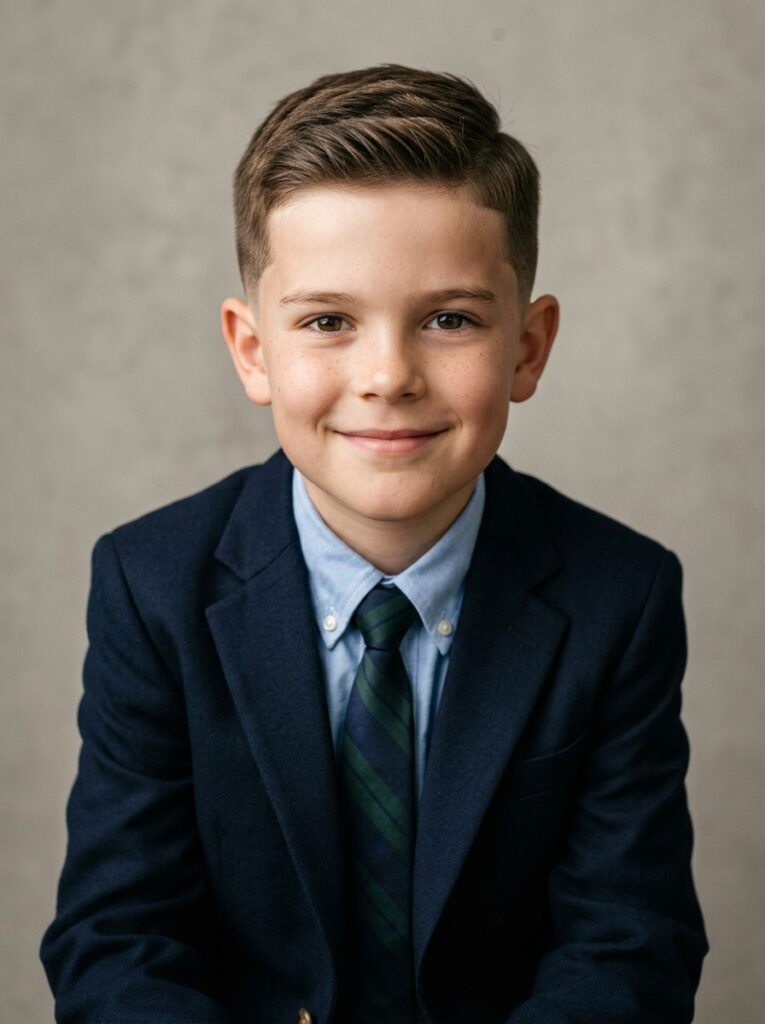
A square face has a wide forehead, a strong jaw and visible corners at the jawline. That structure is an asset, not a problem. The job of the haircut is to balance it rather than double down on it.
A textured crop with a soft fringe works because rounded texture above offsets the straight lines below. A side part does the same thing through its diagonal parting, softening the horizontals of both forehead and jaw at once.
The crew cut and the Ivy League both suit a square face, but only with a specific modification. Leave enough length on top for natural texture and slight movement at the crown. Cut either one perfectly flat against the skull and the jaw becomes the only feature anyone sees. The Ivy League is the more reliable of the two for school, since it is formal enough for photographs and relaxed enough for a Tuesday.
Heart: The Fringe Does the Work
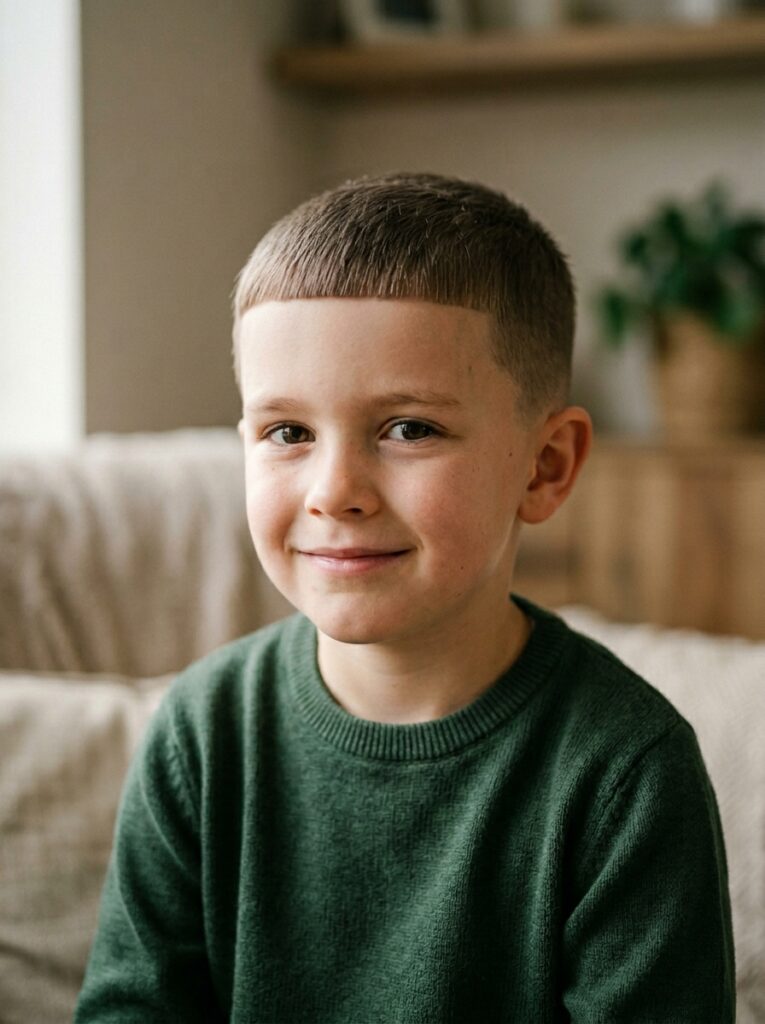
A heart face is widest at the forehead, has high cheekbones, and narrows to a relatively pointed chin. The effect is top-heavy, and one tool fixes it better than anything else.
A fringe that partly covers the forehead reduces its visible width and adds a horizontal element lower down the face. A textured fringe, a French crop or a side-swept fringe all achieve it with a different feel.
The French crop is the strongest of the three. The blunt horizontal fringe gives the eye a lower edge to read instead of the full forehead above it, and it holds its position by weight rather than product. No daily styling, no arguments before school.
Avoid anything that sweeps the hair fully back. A slick back or a very tall quiff exposes the whole forehead and leaves the narrow chin looking narrower by comparison.
Oblong: Add Width, Not More Length

An oblong face is clearly longer than it is wide, with fairly even width from forehead to jaw. Everything that helps a round face hurts this shape, and the reverse is true as well.
The goal is horizontal movement. A comb over with a low fade sweeps hair across the forehead and breaks the vertical run of the face. The low fade also leaves some hair at cheekbone level, which adds apparent width instead of stripping it away.
Keep the top at medium length. A very short top on an oblong face leaves the full length exposed with nothing to counter it, and tall quiffs or pompadours make the proportion worse rather than better.
Diamond: Widen the Ends, Calm the Middle

A diamond face has a narrow forehead, prominent cheekbones as the widest point, and a narrow jaw. It tapers at both ends, which makes it the least common shape on this list and the one most worth discussing with the barber before cutting starts.
Some volume at the crown widens the apparent forehead and balances the cheekbones from above. A fringe helps for the same reason, adding horizontal width at the narrowest part of the upper face.
The one thing to avoid is a skin fade or very close crop at the sides. Leaving some hair at cheekbone level softens their width. Taking it all off exposes the widest point completely and exaggerates the taper above and below it.
The Mistakes That Repeat Most Often
Knowing what not to pick is as useful as knowing what to pick, and the errors follow a pattern.
Round faces with wide untapered sides look wider. Oblong faces with tall styles look longer. Heart faces with fully swept-back hair look top-heavy. Square faces with flat tops look more angular. Diamond faces with skin fades lose the softening they needed at the cheekbones.
None of it is permanent. Hair grows, and the next appointment is a few weeks away. But a barber who is told the face shape before picking up the clippers avoids all five without being asked.
When the Haircut Itself Is the Problem
For some boys, face shape is not the obstacle. Getting through the appointment at all is. If haircuts in your house involve screaming, swatting or refusing to sit, that is a sensory issue rather than a behavioural one, and it is far more common than most parents realise.
A barbershop stacks several triggers at once. The cape around the neck is an unfamiliar fabric. Clippers vibrate against the scalp and buzz near the ears. Cut hair falls onto the skin. The room is bright, loud and full of strangers.
Pediatric occupational therapists have practical answers for this. Writing for North Shore Pediatric Therapy, an OT recommends deep pressure and heavy work in the weeks before an appointment to help regulate the nervous system, and notes that the right tools depend on the child’s own sensitivity and age rather than a single fixed method.
A few practical adjustments help immediately. Book an exact appointment time so there is no waiting. Bring noise-reducing headphones. Use a familiar towel from home instead of the salon cape. Ask for scissors rather than clippers if vibration is the trigger.
Choosing a low-maintenance cut matters more for these boys than for anyone else, simply because it means fewer appointments. Our guide to short haircuts that need zero morning effort covers the styles that stretch furthest between visits.
What to Say at the Barbershop
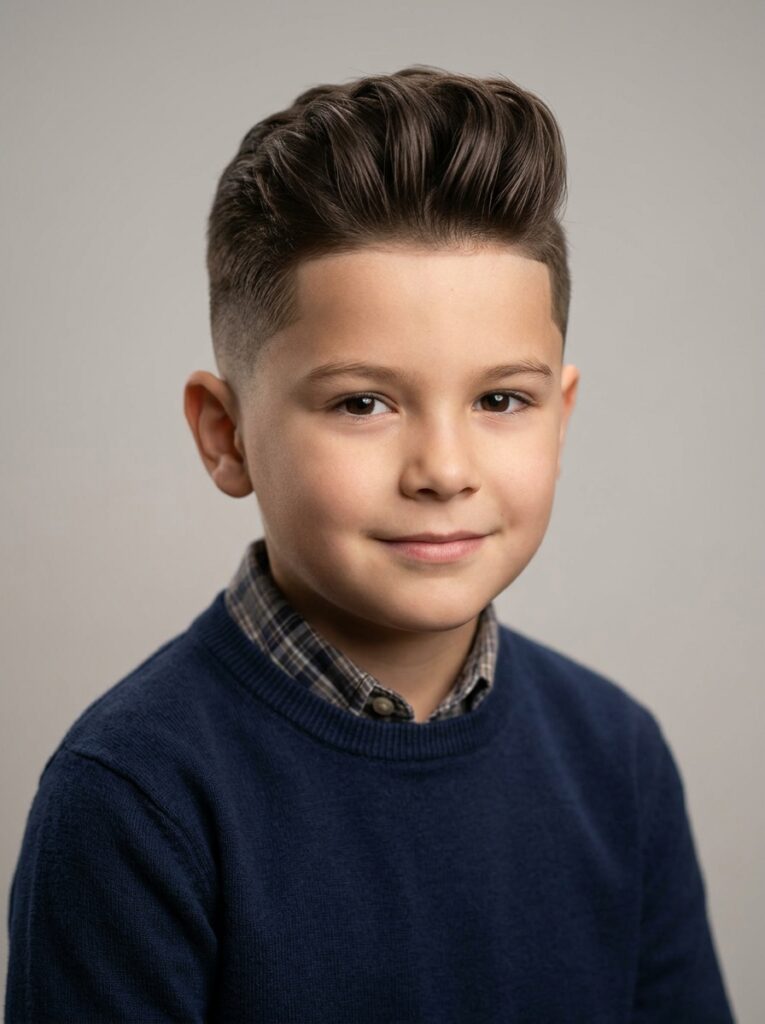
Two minutes identifying the face shape is worth more than twenty minutes scrolling for photos. Then turn it into one sentence for the barber.
Something as simple as “he has a round face, we want some height on top” or “his forehead is wide, so we’d like a fringe” gives the barber the two things they need. Most can assess a face shape in seconds anyway, but saying it out loud removes any guesswork about what you are hoping for.
Name the cut too, not just the length. Asking for a textured crop or a French crop by name means the barber works toward a shape rather than simply shortening what is there. If you are not sure which cut fits the texture he has, start with our guides to the textured crop for boys and boys’ haircuts for curly hair.