Rug size for an L-shaped sectional: how to measure and place it
An L-shaped sectional covers two sides of a seating area. A rug that suits a standard sofa often looks lost in front of one. It ends up floating in the corner of the L, and the whole room reads smaller than it is.
Choosing the right rug size for an L-shaped sectional comes down to three measurements and one decision about legs. This Fivaan guide covers a tape measure method, the three placement options and the mistakes that make a good rug look wrong.
For most L-shaped sectionals, an 8×10 rug is the safest size. A 9×12 suits larger sectionals or rooms where every leg sits on the rug. Tuck it 6 to 8 inches under the front of both sides. Let it extend 12 to 24 inches past each arm. Measure first, then round up to the next standard size.
What size rug do you need for an L-shaped sectional?
Most L-shaped sectionals need an 8×10 or 9×12 rug. The right one depends on how big your sectional is and whether the rug goes under the front legs or under every leg.
Here is how the common sizes usually play out:
- 6×9: Works only with a compact apartment sectional, and only with the front legs on the rug. Check the math in the next section before buying.
- 8×10: The default for a standard L-shaped sectional with the front legs on the rug.
- 9×12: Fits a large sectional with front legs on, or a mid-size sectional with every leg on.
- 10×14: For oversized sectionals, open-plan rooms and layouts that also include chairs across from the sofa.
A 5×8 is almost always too small. It fits inside the L without touching the sofa, which is the floating look this guide tries to avoid.
How do you measure your sectional for a rug?
Measure three things: the long side, the short side and the depth. Then add a set amount for the tuck and the overhang. The result tells you the smallest rug that will work.
- Measure the long side. Run the tape along the back of the longer run, from the outside corner to the far arm. Call it A.
- Measure the short side. Do the same on the shorter run, from the outside corner to its arm. Call it B.
- Measure the depth. Go from the back of the sofa to the front edge of the seat. Call it D.
- Work out the rug length. Take A, subtract D, then add 20 to 32 inches.
- Work out the rug width. Take B, subtract D, then add the same 20 to 32 inches.
- Round up. Pick the next standard rug size that covers both numbers.
The extra 20 to 32 inches is two allowances added together. About 8 inches goes under the front of the sofa so the legs rest on the rug. The other 12 to 24 inches is the overhang past the arm.
A worked example
Say your sectional measures 112 inches on the long side and 86 inches on the short side. The depth is 38 inches.
- Length: 112 minus 38 is 74. Add 20 to 32 and you get 94 to 106 inches.
- Width: 86 minus 38 is 48. Add 20 to 32 and you get 68 to 80 inches.
A 6×9 rug is 72 by 108 inches. It covers the minimum, with almost nothing to spare. An 8×10 is 96 by 120 inches. It covers the generous end comfortably and leaves room for a side chair. In this example the 8×10 is the better buy.
Tape it out before you buy
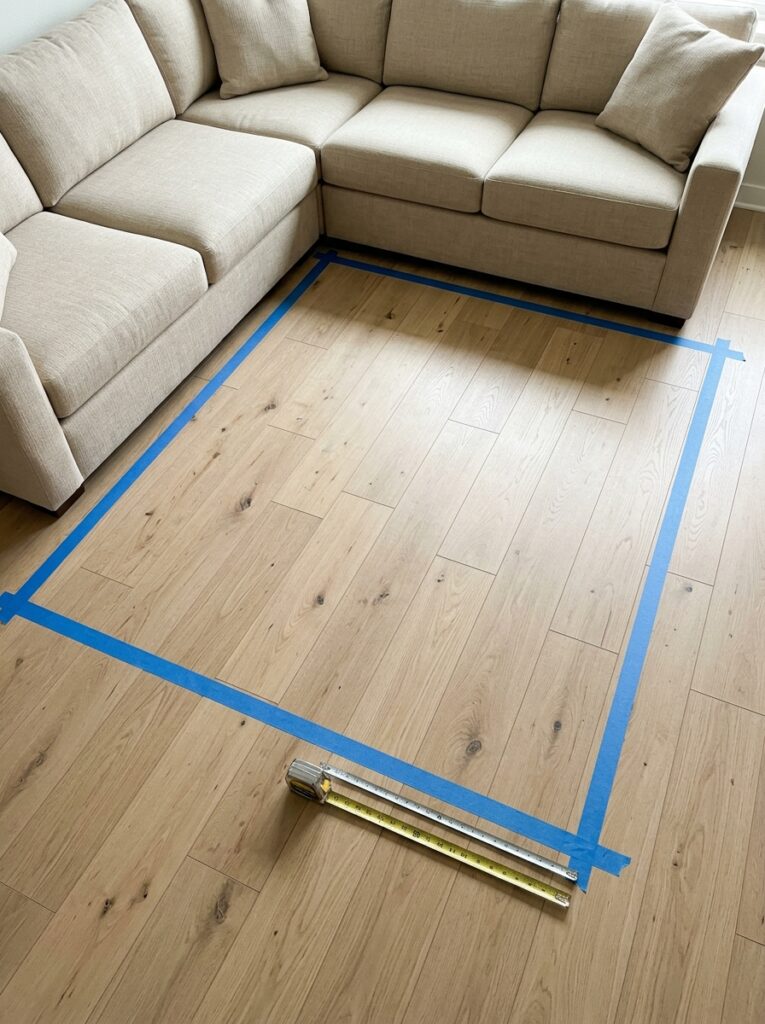
Painter’s tape on the floor answers the question faster than any chart. Mark the outline of the rug you are considering and live with it for a day. Walk around it. Sit on the sofa and look at where the edges land.
If the tape stops short of the arm, the rug is too small. If it runs into a doorway or under a radiator, it is too big for that wall.
Front legs, all legs or no legs: which placement fits your room?
The front-legs placement suits most living rooms. All legs on works best in large or open-plan rooms. A rug with no legs on it only suits very small spaces.
Front legs on the rug
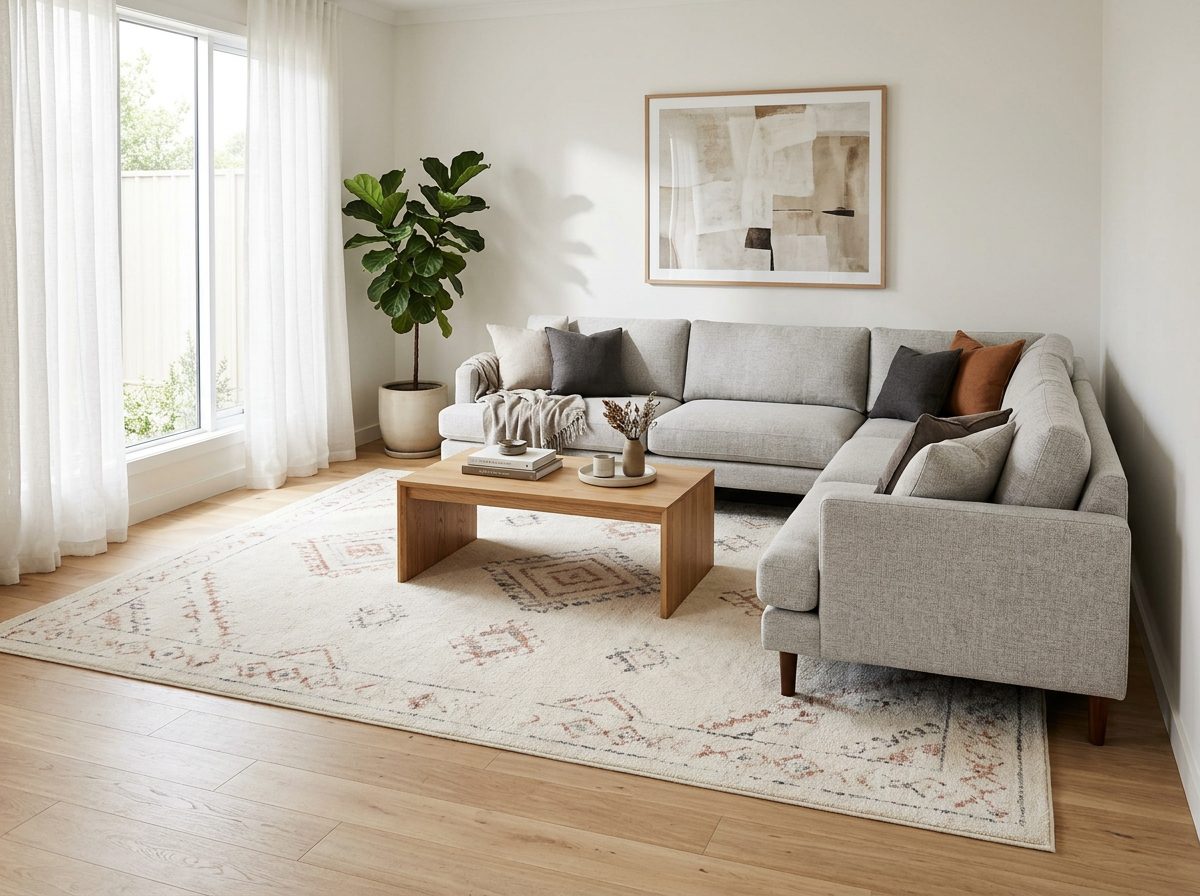
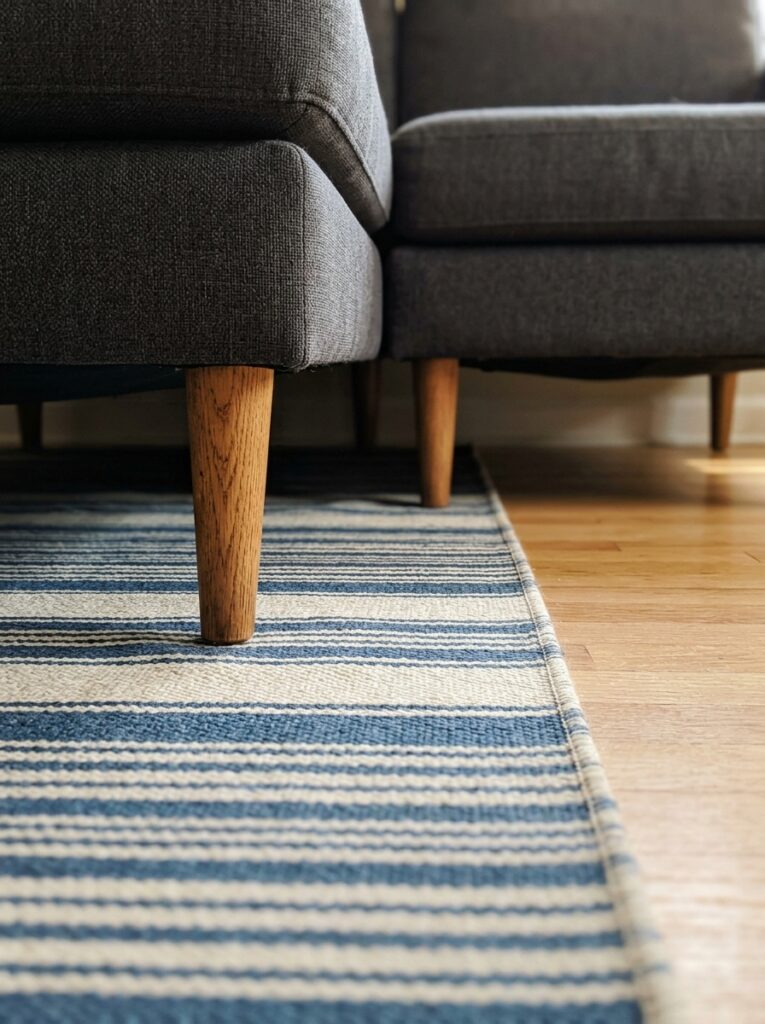
The front legs of both runs sit on the rug, and the back legs stay on the floor. The rug tucks into the inside corner of the L and anchors both sides at once. You get the connected look of a big rug without paying for one that reaches the wall.
This placement is the reason an 8×10 works for so many sectionals. The rug only has to cover the open space inside the L plus the allowances.
All legs on the rug
Every leg of the sectional sits on the rug, with a visible border of rug behind the back. The rug defines the whole seating zone. This is the strongest option when the sectional floats in the middle of a room.
All legs on needs a much bigger rug. As a rough check, the rug should be at least 12 inches longer than A and 12 inches wider than B. For the 112 by 86 inch example above, that means at least 124 by 98 inches. An 8×10 falls short on both sides, so a 9×12 is the minimum.
No legs on the rug
The rug sits inside the L and the sofa does not touch it. This is the only option when the room is too small for anything else, or when you already own a smaller rug.
If you go this way, keep the gap between the rug and the sofa front to a few inches. A wide gap makes the rug look like an island. Make sure the rug is at least as wide as the coffee table area it sits under.
What changes when the sectional floats in an open-plan room?
A floating sectional needs a rug large enough for every leg. In an open-plan room the rug is doing a second job. It marks where the living area ends and the kitchen or dining area begins.
The back of a floating sectional is on show. With the front-legs placement, the back legs sit on bare floor in plain view, and the rug looks like it slid out from under the sofa. All legs on fixes that.
Keep a clear walkway behind the sofa. Apartment Therapy’s living room measurement guide suggests about 30 to 36 inches of walkway between pieces. If the rug pushes the sofa so far back that this path disappears, choose a smaller rug and switch to front legs.
How much floor should show around the rug?
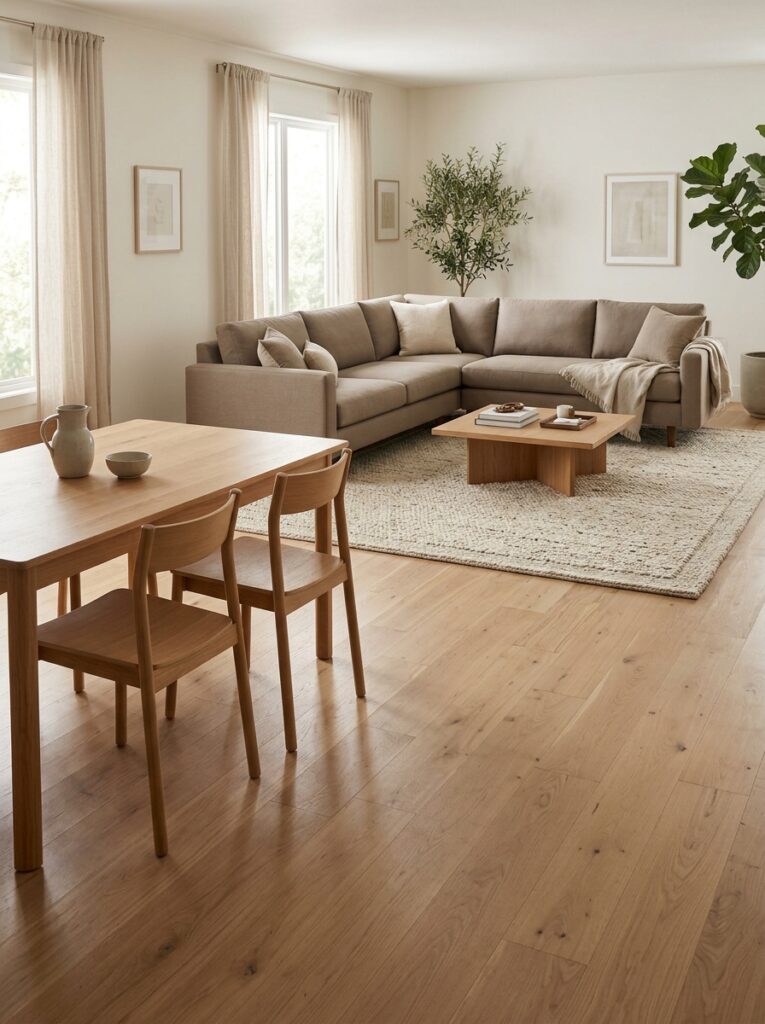
Leave 12 to 18 inches of bare floor between the rug and the walls in a small room, and about 24 inches in a large one. The same Apartment Therapy guide sets these ranges. It also says a rug should never sit closer than 6 inches to a wall.
That border matters more than people expect. A rug that nearly touches every wall looks like wall-to-wall carpet that was cut badly. A band of floor around it makes the seating area read as a deliberate zone.
When a sectional sits against a wall, the rug edge on that side disappears under the sofa. The border rule then applies to the two open sides. Check both before you commit to a size.
Where should the coffee table sit on the rug?
The coffee table should sit fully on the rug, centered on the open part of the L. All four legs belong on the rug. A table with two legs on and two off rocks slightly and looks like an afterthought.
Leave about 14 to 18 inches between the table and the front of the sectional. That gap lets you reach a drink without stretching and still walk past your knees. Measure from the seat edge, not the arm.
An L-shaped sectional has two fronts, so place the table where both runs can reach it. That is usually closer to the inside corner than to either arm. Once the table is placed, see these coffee table styling ideas for what goes on top of it.
Why doesn’t the rug match the size on the label?
Rug sizes are names, not exact measurements. Some rugs sold as 8×10 actually measure 7 feet 10 inches by 9 feet 10 inches. That missing 2 inches in each direction can break a layout that only just worked on paper.
Always read the actual dimensions in the product listing. Then compare them with your tape measure numbers, not with the size name. If your math lands within a couple of inches of a standard size, size up.
Pile height and how the sectional sits
Low-pile and flat-woven rugs work best under a sectional. Furniture legs sit level on them, and the sofa does not tilt.
A thick shag or high-pile rug causes problems with the front-legs placement. The front legs sit on deep pile while the back legs sit on the floor. The seat can tip back slightly, and the modules of a sectional may stop lining up. If you love a plush rug, all legs on avoids the tilt.
Also check any door that swings over the rug. A thick rug and a thick pad together can stop a door from clearing.
Rug pads and slipping
A rug pad keeps the rug from shifting and stops it from creeping out from under the sofa. Choose a pad trimmed slightly smaller than the rug so the edges lie flat.
Pads also matter for safety. A rug that slides or curls at the edge is a trip hazard. The CDC’s STEADI fall prevention brochure advises removing small throw rugs or using double-sided tape to keep rugs from slipping. That advice is aimed at older adults, but a slipping rug is a hazard for anyone.
Can you use a round rug or two rugs with an L-shaped sectional?
A round rug can work with an L-shaped sectional when the open space inside the L is close to square. A rectangle mirrors the shape of the sofa, so it usually looks more settled. A round rug softens the hard corner and suits a round coffee table.
The size rule for a round rug is the same as for a rectangle. The rug should reach under the front legs of both runs. In most living rooms that means a round rug of 8 feet or more.
Layering a small rug over a larger one
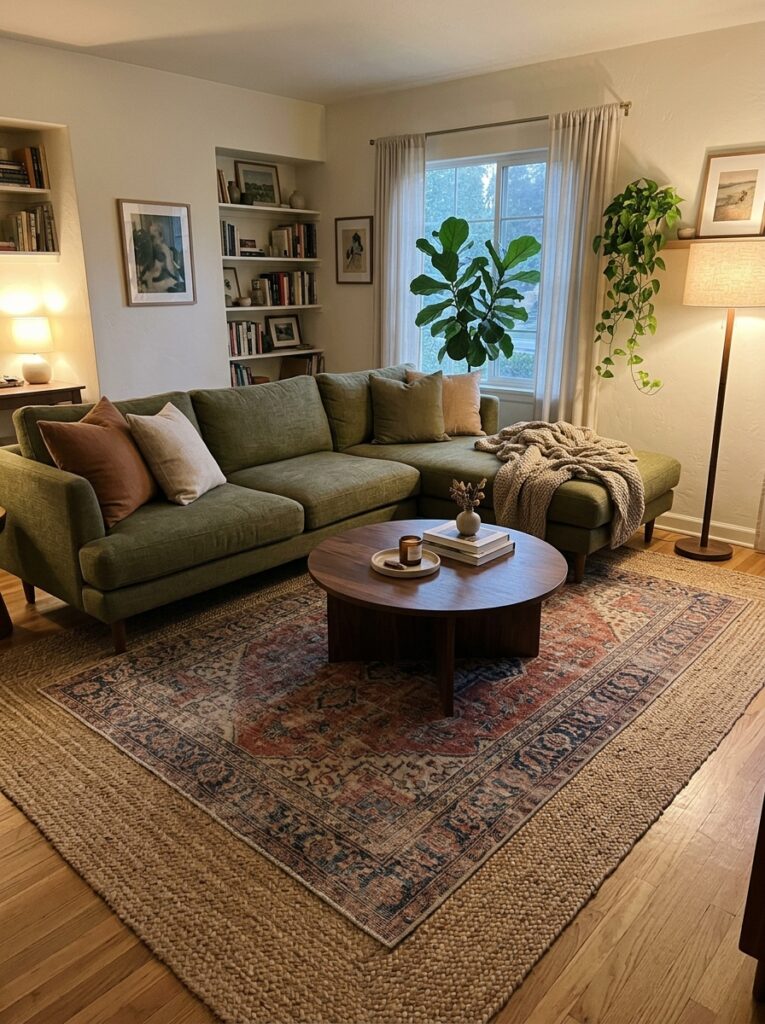
Layering fixes a rug that turned out too small. Put a large, plain rug down first, such as jute or a flat-woven cotton. Then lay the smaller rug on top, centered on the coffee table.
The large base rug does the sizing work. The smaller rug adds the color and pattern. A big plain rug often costs less than a big patterned one, so layering is also a useful budget decorating move.
Layering also adds the kind of texture that makes a room feel warmer. A wool rug over jute is a simple version of the layered look in these cozy living room ideas.
What are the most common rug mistakes with sectionals?
The most common mistake is buying a rug that is too small. Most of the others come from skipping the measurements.
- Sizing the rug to the room instead of the sofa. A rug that fits the room’s proportions can still miss the sectional’s legs entirely.
- Buying by the size name. An “8×10” that measures a few inches short can fail a tight layout.
- Mixing placements. The front legs of one run on the rug and the other run off it looks like a mistake. Treat both runs the same.
- Ignoring the arm ends. A rug that stops short of the arm makes the sofa look too big for the room.
- Letting the rug touch the walls. Leave at least 12 inches in a small room.
- Skipping the pad. The rug will shift toward the open side of the L every time someone sits down.
- Choosing deep pile for front legs only. The sofa ends up tilted.
How do you keep a rug under a sectional looking good?
Vacuum it regularly and turn it once or twice a year. The Carpet and Rug Institute’s cleaning and maintenance guidance recommends vacuuming at least once a week, and more often in high-traffic areas. The strip in front of a sectional is exactly that kind of area.
Turning the rug 180 degrees spreads wear more evenly. The side under the sofa gets almost no foot traffic and no sun. The open side gets both.
If your rug has fringe, vacuum from the center toward the fringe with gentle suction. That technique, also from the Carpet and Rug Institute, keeps the strands out of the beater bar.
Frequently asked questions
Is an 8×10 rug too small for an L-shaped sectional?
An 8×10 is usually the right size for a standard L-shaped sectional with the front legs on the rug. It becomes too small when the sectional’s long side runs much past 10 feet, or when you want every leg on the rug. Run the measuring method above to check. If the numbers land close to 96 by 120 inches, size up to a 9×12.
Should my rug go all the way under my sectional?
A rug only needs to go all the way under your sectional if the sofa floats in the room or you have a large open-plan space. Against a wall, the front-legs placement looks just as finished and costs less. Choose all legs on when the back of the sofa is visible from another part of the room.
Does a chaise sectional need a different rug size?
A chaise sectional uses the same method, with the chaise counted as the short side. Measure from the outside corner to the end of the chaise for B. Because a chaise is often not against a wall, check how the rug looks from the open side. A rug that stops short of the chaise end tends to look cut off.
What size rug do I need if I also have chairs across from the sectional?
Add the chairs to the measurement. The rug should reach under the front legs of the chairs as well as the sectional. That usually pushes a standard layout from an 8×10 to a 9×12, or from a 9×12 to a 10×14. Tape out the chair positions before you decide.
Can a rug be too big for a sectional?
A rug is too big when it leaves less than about 12 inches of floor at the walls in a small room. It is also too big if it blocks a door or a heating vent. In those cases, drop one size and use the front-legs placement.
Choosing the right rug size for an L-shaped sectional
The right rug size for an L-shaped sectional starts with a tape measure, not a size chart. Measure the long side, the short side and the depth. Add the tuck and the overhang, then round up to the next standard size. For most rooms that lands on an 8×10 with the front legs on the rug. Larger sectionals and floating layouts need a 9×12 or more.
Before you order, tape the outline on the floor and live with it for a day. If the tape reaches past both arms and leaves a clear border at the walls, you have the right size. For more practical layout help, browse the rest of Fivaan’s home decor guides.